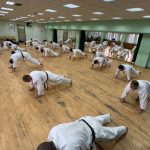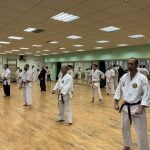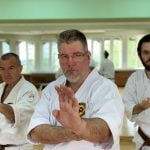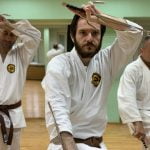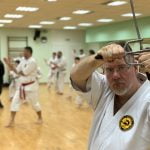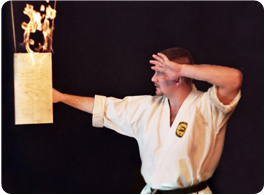
Here is a brief overview of our beginner program.
Our training method is somewhat different from those used in other clubs. Beginners often give up, and the classical approach—breaking everything down and explaining it step by step—has proved rather ineffective. Such an old-fashioned method requires a separate group for complete beginners.
A much better approach has been to include beginners in the intermediate group, which trains students up to green belt. At first it feels a little chaotic, but after two or three sessions they grasp the basics and absorb the techniques and self-defense method much faster than they do through classical karate instruction.
This approach also keeps many more beginners in training because they immediately practice interesting material, even though at that moment they may not yet have the technical skill or understanding to perform it properly. They nevertheless learn quickly and soon become part of the group.
Since we introduced this method, significantly more students have continued training. Adults usually join because they want to learn something practical as quickly as possible. They do not want to spend months practicing oi-tsuki in kiba-dachi, which is why this training method is more effective. These are the basic techniques covered by beginners:
 1. Tsuki
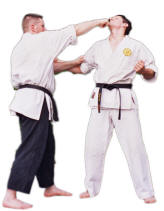 1. Tsuki
First, learn how to use your fist. This is the simplest technique. Always aim at the opponent’s nose. You do not need to deliver the most powerful punch of your life; too much force will only make you miss the target. Use a quick and precise straight punch rather than a roundhouse punch. Use a grabbing block (kake-uke) to catch the opponent’s arm, then pull him toward you (hikite) to make the punch more powerful. Use a natural stance (shizen-dachi).
 2. Kinteki geri
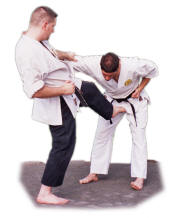 2. Kinteki geri
Move to the side (tenshin), away from the line of the opponent’s punch, and settle into cat stance (neko-ashi-dachi) while catching his arm with kake-uke. From this position, a kick to the genitals is a natural choice. Use your front leg and do not try to put too much force into the movement. Kinteki geri is delivered like a whip; retract the leg quickly and put it back on the floor so the opponent cannot catch it and take you down. In self-defense, forget high roundhouse and spinning kicks—they do not exist in traditional karate.
 3. Hiza geri
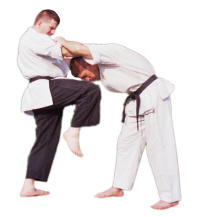 3. Hiza geri
The photograph shows a knee strike to the opponent’s head, although a knee strike to the genitals is a more common choice. This technique is a useful defense against an opponent who tries to grab or push you with both hands. Stand naturally in shizen-dachi and, when the opponent is close enough, rise sharply into crane stance (tsuru-dachi). Use your forearms to control both of his arms and strike the groin with your knee. It is important to pull him forcefully onto the knee with your arms; this pulling action (hikite) doubles the power of the strike.
 4. Empi uchi
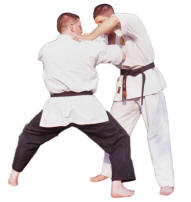 4. Empi uchi
Elbow techniques are very powerful and effective at close range. To make them effective, you must use your whole body mass: enter (irikumi) into horse stance (kiba-dachi) and strike using the weight of your body. A common mistake is to make contact with the entire forearm against the opponent’s chest muscles. Instead, drive the tip of the elbow (olecranon) into the opponent’s ribs. Perform hikite with the other hand.
 5. Ushiro empi
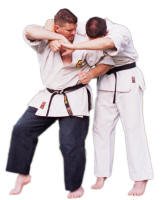 5. Ushiro empi
A sudden grab from behind is a realistic possibility. Use your elbow to escape. From a natural stance, move abruptly and slide quickly into neko-ashi-dachi, delivering a backward elbow strike with your whole body mass. During the defense, slide slightly to the side so that your elbow is aligned with the opponent’s position.
 6. Sagurite
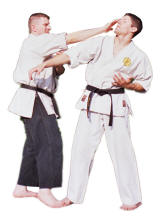 6. Sagurite
Your opponent is usually stronger than you, so you must choose your response carefully because you may not get another chance. An eye attack (sagurite) is a simple and effective technique. It requires neither great body mass nor strength. Evade the attack (tenshin), deflect the opponent’s arm with your rear hand, and use the fingertips (nukite) of your front hand to make a quick, whipping attack toward the eyes.
 7. Shuto uchi
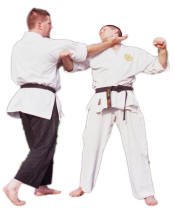 7. Shuto uchi
The knife hand (shuto) is one of karate’s most dangerous weapons. A strike to the throat can be fatal, so the primary target is the jaw joint, where a knockout is easiest to achieve. Shuto can also be used to block an opponent’s roundhouse punch. Okinawan folk tales claim that a knife-hand block can break the bones of the arm. The key is surprise: deflect the opponent’s attack, enter, and cut across the opponent’s jaw with the knife hand. Make a rapid movement toward the attacker (irikumi); because of the speed, the opponent is struck while you are effectively in a transitional cross stance (kosa-dachi).
 8. Yama uke
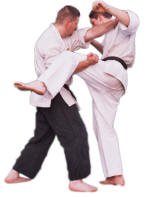 8. Yama uke
Yama uke means “mountain block.” This position from the kata Passai is used to catch the opponent’s kick. It is performed in front stance (zenkutsu-dachi). You must be as firm as a mountain. Use your front arm to scoop (sukui) the opponent’s leg and your rear hand to grab his shoulder. Keep the rear arm in the position of an upper block (age-uke) so that you remain protected from a counterattack. The opponent can easily be thrown with a sudden rotation, which is the next movement in the kata.
 9. Fumi kiri
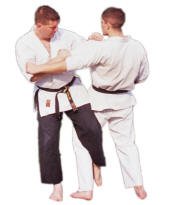 9. Fumi kiri
This basic throw is known in judo as osoto-gari. However, in his book Sensei Funakoshi called it fumi kiri, so that is the expression I use. It is one of the simplest ways to bring an opponent to the ground by tripping him. In many old Okinawan kata, this technique is hidden within mae geri. Fumi kiri is performed during the returning phase of the mae geri movement: use your calf to sweep the opponent’s leg away.
 10. Otoshi uchi
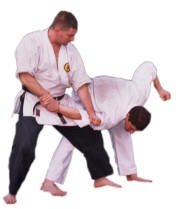 10. Otoshi uchi
Elbow locks have long been used as control techniques in police work. This application is often hidden in kata and appears as gedan-barai. You must grip the opponent’s wrist and the clothing over his triceps. The clothing is used to establish control; if the opponent is wearing no sleeves, grip the skin over the triceps, which is extremely painful. Then apply the elbow lock. The technique requires substantial force, and the most common mistake is pressing the elbow with the hand. Instead, grip the clothing on the upper arm and apply pressure with your forearm.
 11. Kubiwa
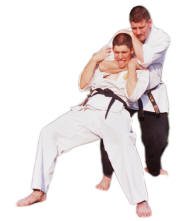 11. Kubiwa
There are many variations of this technique, which is related to what is known in judo as shime. It can be used to control, choke, or take down an opponent. In kata, it is hidden in the movement of an upper cross block (juji-uke). Here I will show my favorite variation from the kata Kushanku. Move to the outside of the opponent’s attack and catch his arm. Quickly grab his hair with your other hand, step behind him, and apply the choke.