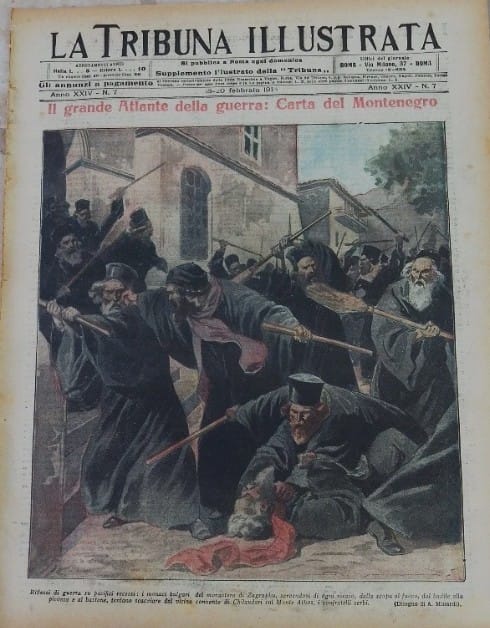
It is commonly said that Mount Athos is a harmonious community where monks from various countries live in brotherly love. However, not everything is so perfect, and in the past, there have been different situations. I will share with you photographs that speak of conflicts within the monastery regarding the status of the monastic mountain after the fall of the Turkish Empire. Much of the material posted here has never been publicly published..
Bulgarian monks beat the monks of Hilandar.
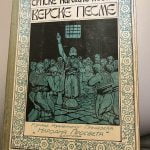
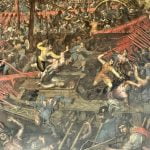
Below the cover image is the comment: ”The war conflicts have also spread to the monastic cells.: Bulgarian monks of the Zograf Monastery, using all means — from shouting to rifles, from sticks to pistols — are trying to drive out the Serbian monks from the neighboring Hilandar Monastery on Mount Athos.” (La Tribuna Illustrata, Anno XXIV, N. 7, 13-20 February 1916.)
The picture is from an Italian magazine La Tribuna Illustrata from 1916, the most-read Italian weekly at the time. In the Balkans, the First World War is raging, Bulgarians are on the side of the Austro-Hungarians, Serbs, Russians, and Greeks on the opposite side. At a time when the Germans had military successes on the battlefield, it encouraged Bulgarian monks to try to reclaim the Hilandar Monastery. The situation on the battlefield was reflected in the monasteries of Mount Athos..
Aleksandar Obrenović managed to return Hilandar under Serbian administration. Witnesses say that the plan was also to return Zograf under our administration, but there was no money in the state treasury.. I wrote about it, and this picture is evidence that the historical pendulum swung back and forth many times and that anything could have happened..
A month earlier, in January 1916, there was a landing of English and French units. They searched the monasteries for German agents, weapons, and radio transmitters.. Russian monks were placed under investigation on suspicion that Russia was arming its monks, and some monks were imprisoned and interrogated. This caused serious tensions within the monastic community..
It should be noted that it takes 2 hours on foot from Zograf to Hilandar, and this is not a random occurrence. A group of monks from Zograf came organized and were armed..
Russian monks beat Bulgarian monks.
I was intrigued by this picture, so I began to research the background of this event. A year earlier, something similar happened to the Bulgarians. We don’t have a picture of this event, but we have a newspaper article from Dutch newspapers. The daily newspaper “De Tijd” edition of August 17, 1915.. 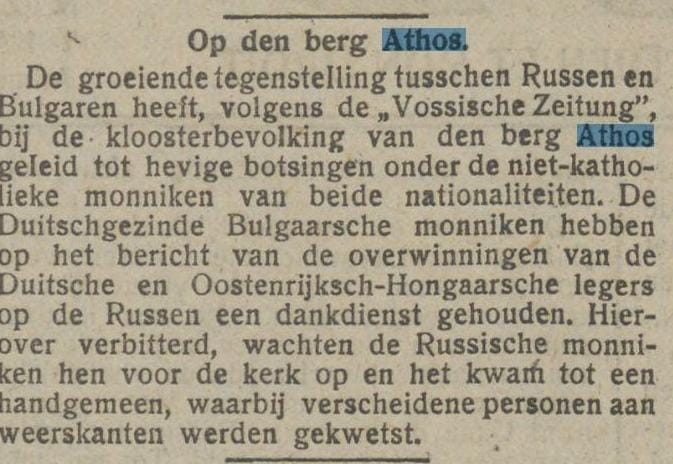 ”According to „Vossische Zeitung“, increasing rivalry between Russians and Bulgarians led to fierce conflicts among non-Catholic monks of both nationalities in the monastic community on Mount Athos.. Bulgarian monks, inclined towards the Germans, held a thanksgiving when they heard the news of the victories of the German and Austro-Hungarian armies over the Russians..
Angered by this, Russian monks waited for them outside the church, and a fight broke out in which several people on both sides were injured..”
One wonders how it came to this? What disturbed the peace of God? Let’s go a little further back in history….
Greece occupies Athos.
Mount Athos was under Turkish administration until 1912. During the Balkan Wars, Greece occupied Mount Athos, which the Turks handed over without a fight. Then the Greek army and guerrilla units entered various monasteries, and many photographs testify to this, some of which I have posted here..
From 1912, a transitional period begins when discussions about the future status of the monastic republic were still ongoing. The Russians advocated the idea that Athos should be an independent monastic republic like the status of the Vatican; however, Greek monasteries leaned towards the solution that Mount Athos should become part of the Greek state. There are many pictures from that period..
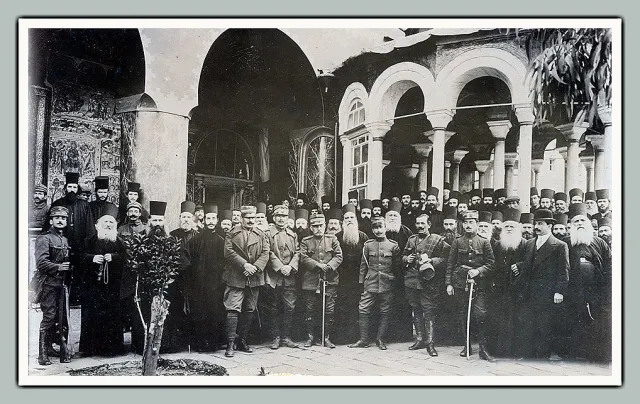
Greek soldiers in the Vatopedi Monastery during the First World War. We do not have an exact date..
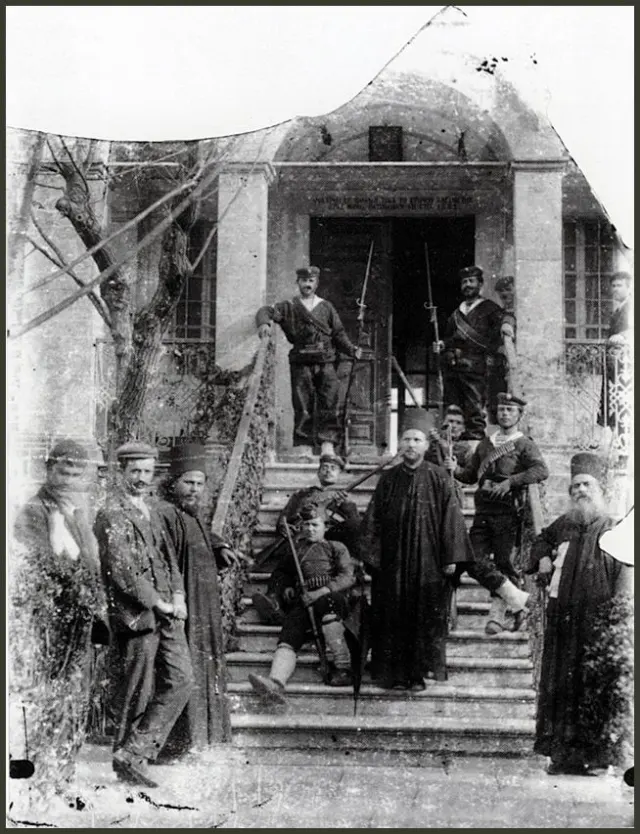
Greek guerrillas in the Russian skete. First World War..
Bulgarian military expedition.
I draw attention to this little-known photograph from the Zograf Monastery when the Bulgarian army was lined up in the courtyard. The picture is from 1912, during the Balkan Wars..
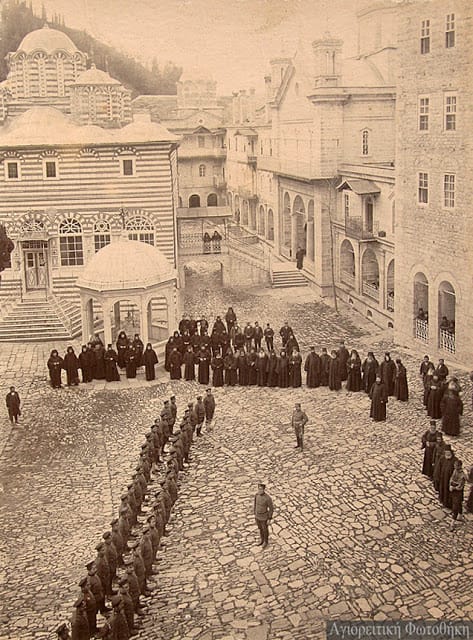
Bulgarian company in the Zograf Monastery on Athos, led by their commander Lieutenant Georgi Tsvetkov — 1913..
Translation from Bulgarian to Serbian.:
”The Balkan War has stories that researchers avoid, and soldiers do not study. They do not contain brilliant victories and heroism, but only the quiet military feat — unjustly forgotten. One such story takes us to the Bulgarian company in the Zograf Monastery..
On November 2, 1912, a week after Thessaloniki was liberated from the Turks by allied units of Greece and Bulgaria, Greek warships landed on Mount Athos, which was under Ottoman rule..
On Mount Athos, there remained only a small Ottoman police-administrative detachment: a few gendarmes and a local Turkish administrator. They surrendered to the Greeks without a fight. Orthodox Greece “liberates” and annexes the thousand-year-old cradle of Orthodoxy, without informing its allies and without any international reaction..
„The entire Athos Peninsula was occupied by us and is under our occupation, in a state of blockade according to Greek laws…“ — we read in the decree of Greek King George I..
After the “victory” over the Ottomans on Athos, Greek detachments spread through the monasteries and sketes, presenting themselves as “pilgrims.” For monks of Slavic origin, persecution begins. The Greek army invades the Russian skete of St. Elijah and arrests all Bulgarian novices. Then they literally occupy the Russian monastery of St. Panteleimon, confiscating the monastery ship..
The Bulgarian command in Thessaloniki reacts to Greek arbitrariness on Athos, so two weeks after the landing, the head of the 7th Rila Division, General Georgi Todorov, sends there a Bulgarian unit of 62 men.. It was a company from the 14th Macedonian Infantry Regiment, entrusted to reserve lieutenant Georgi Tsvetkov.. He graduated from the Spiritual Academy in St. Petersburg and was well acquainted with the specifics of monasticism..
The Thessaloniki headquarters used the Greek invented formulation about the presence of soldiers on monastic territory and also declared the half-company as “pilgrims” on Mount Athos. They arrive at the monastery at the end of November 1912. At that time, there were Bulgarian monks not only there but also in many sketes on Athos. Our boys, stationed in the monastery, were supposed to turn it into a refuge for all Bulgarian monasticism, which undoubtedly suffered from the arbitrariness of the like-minded Greek “pilgrims” in greatcoats..
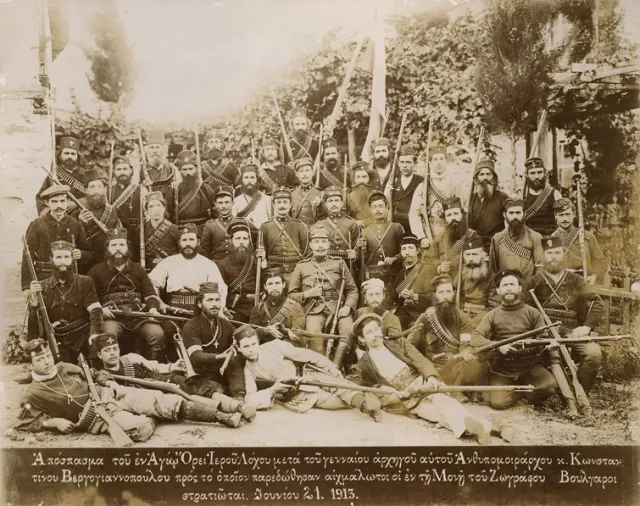
The Bulgarian unit was small compared to 800 Greeks who occupied Athos but still sufficient to restrain their intentions towards Slavic communities..
Help from the Bulgarian command is also sought by the abbot of the Russian St. Panteleimon.. The operational correspondence of the 7th Rila Division shows that the headquarters in Thessaloniki was preparing for Athos two more companies, but they did not depart, probably due to more important needs on the front. Thus, the opportunity to establish a significant Bulgarian military presence on Mount Athos was missed, which would have built a shield for non-Greek monks, and after the war, become a factor that would help resolve the fate of Athos not in the direction of Greek interests but in the direction of all Orthodoxy. But for Ferdinand and the main command, this was obviously not of importance..
Although far from active combat operations, Bulgarian soldiers were not resting in the silence of the Zograf community. On Athos, as elsewhere, Greeks did not consider Bulgarians allies. They did everything they could to eliminate Bulgarian fighters in Zograf. Through secret channels, the manager of the Bulgarian metropolis in Thessaloniki, Archimandrite Euthymius, receives disturbing news, which he forwards to the Macedonian military governor in Serres, General Valkov.:
“…Greek military authorities on Mount Athos have tried several times to expel Bulgarian soldiers from the monastery but have not succeeded. Measures have been taken to thwart all their future attempts to expel Bulgarian soldiers from the monastery..“
In February 1913, a new incident occurs. Six Bulgarian soldiers were sent from Zograf to collect mail received in the Athos capital, Karyes. Due to accumulated snow, they lost their way and found themselves in front of the Vatopedi Monastery, where a Greek detachment was stationed. Their desire to enter the church and light a candle was refused with the words that Bulgarian soldiers were forbidden to enter the monastery..
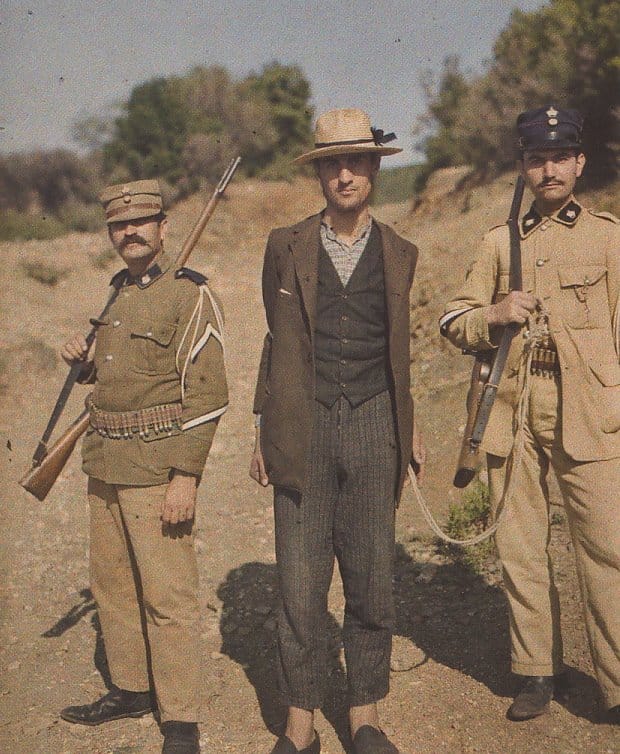
Tensions are high, this man was arrested near the Great Lavra. We have no further information. September 10, 1913, photographed by Stéphane Passet.
Without arguing, the six continued their journey, but the Greeks caught up with them and surrounded them. After a few days, they were sent as prisoners to Thessaloniki and released only after the intervention of the Bulgarian headquarters. At their departure, the Greek commander of Athos smugly told them that he would “tie up and send the rest in Zograf to Athens.“.
Meanwhile, the company commander, Commander Tsvetkov, reports to the headquarters in Thessaloniki that “from all sides, he receives news that the Greeks are preparing to attack our Zograf Monastery with the aim of disarming our soldiers… but he will not allow them to be disarmed.“.
The Bulgarian command, however, remains passive. They had more important concerns. The siege of Adrianople was in a decisive phase, and in Thessaloniki, there was barely one Bulgarian company — too small for its part to be sent to Zograf..
Somewhere at the beginning of July 1913, the Zograf Monastery was surrounded by Greek units, together with armed Greek and Serbian monks and seasonal Vlach workers. In his memoirs, Monk Nil, a Bulgarian from the Serres region, describes that dramatic moment.:
“The Greek command proposed to Officer Tsvetkov to surrender into captivity, but he refused, asking to let his company return to Bulgaria. This was refused, and the company fortified itself in the monastery and did not want to surrender. Then the Bulgarian soldiers were last offered to surrender. If they did not do so — they would destroy the monastery. Then the soldiers and the monastery administration consulted and decided that the company should surrender to save the monastery from destruction..“
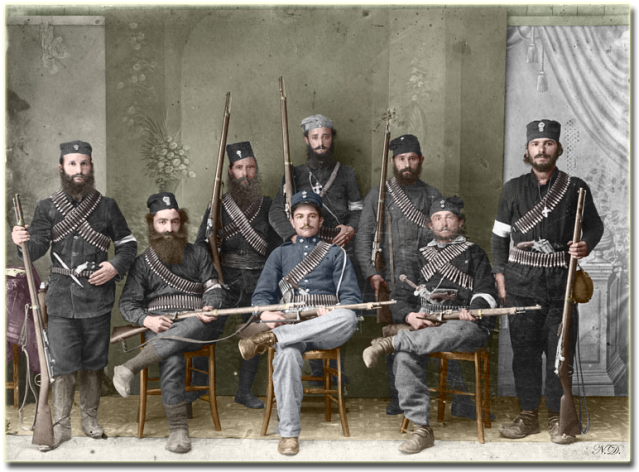
Greek Volunteer Unit for the Liberation of Macedonia..
Russian Archbishop Nikon Rozhdestvensky, who was on Mount Athos at the time, became a witness to Greek treachery. He recounts how the Bulgarian company, which welcomed him with honors in Zograf, was taken into captivity on the island of Cyprus a few days later.:
“A heavy impression was left on us by that celebration of the Greeks over their former allies, who, of course, could not resist.…“
The voluntary surrender of the Bulgarian company was not the only way out of the critical situation. Barricaded in the monastery, our boys could have honorably died as heroes. But with them, Bulgarian monks would have perished, and the monastery would have been at least partially devastated, if not destroyed..
Later impoverishment and the difficult fate of Bulgarian monasticism on Athos under Greek rule show that if in the summer of 1913 Zograf had become the scene of a military conflict, it would have taken years to recover. And who knows if it would not have led to its de-Bulgarization. Therefore, the surrender of our company is equal to self-sacrifice. Fifty-seven Bulgarian boys accepted the humiliation and misery of captivity but saved our greatest shrine abroad from inevitable ruin..”
Taken from Todor Mihailov.
Serbs on the Greek side.
Russia had its stance on the future status of Mount Athos. They wanted Athos to be an international Orthodox zone or at least under the protection of several Orthodox countries Russia, Greece, Romania, Serbia, Bulgaria, and Montenegro.. The goal was to neutralize Greek dominance and protect monks of various Orthodox nations. Greece fought for Athos to be under its sovereignty..
Russia at that time had enormous influence because they had 3,500 monks on Mount Athos in the St. Panteleimon Monastery, the St. Andrew’s skete, and two more sketes. Keep in mind that this was still Tsarist Russia at the time. Their proposal was that each monastery have one representative for 200-300 monks, in this way, Slavic countries would have a majority in decision-making..
At that time, Serbian monks supported the Greek side. The situation at the time must be understood to explain such a Serbian stance. The Serbian army was then concentrated around Kosovo and Vardar Macedonia in the fight against the Bulgarians. Therefore, an alliance with the Greeks against the Bulgarians was of strategic importance. From June 1913, Serbia and Greece were at war against Bulgaria..
According to the official Hilandar historical overview, among those who fought for Mount Athos to become a sovereign part of the Greek state were also Hilandar monks.. On duty as the Athonite Proto in 1913/1914 was Hilandar monk, Proigumen Kliment..
Representatives of 19 monasteries, without the Russian Panteleimon, on September 3, 1913, sent a memorandum to the London Conference requesting the annexation of Mount Athos to Greece; the decision on annexation was made in the Protaton on October 3, 1913, and the original was presented to the Greek King Constantine by a delegation led by none other than Proto Kliment Hilandarac..
Conflicts in Russian monasteries.
We said that the official Russian stance was to create an independent monastic republic, however, at the London Conference, there was a turnaround. The Greeks had a majority in the Protaton, the administration of Mount Athos, so their request for Mount Athos to join the Greek state was supported by England and France. In the war against the Bulgarians, Romania and the Ottoman Empire were involved..
Russian diplomacy tacitly accepted this. However, most Russian monks did not accept that situation and demanded an international Orthodox zone and were against Greek occupation. This led to conflicts..
There was probably a threat that Greece would forcibly take over the Russian monastery and sketes, so it was agreed that Russia would resolve that problem with its monks to avoid casualties and destruction of monasteries. In this way, everyone would preserve their dignity..
The Russian Imperial Army reacted. Soon, a gunboat and two Russian military transport ships arrived. The Russian expedition to Athos in 1913 was led by Archbishop Nikon Rozhdestvensky, along with Professor Sergei Troitsky, while the military action on the ground was carried out by the Russian consul in Constantinople, Alexei Shebunov, relying on soldiers of the 6th Company of the 50th Bialystok Regiment. They arrived on Athos by ships “Donets,” “Tsar,” and “Kherson.” I am quoting the text by Tom E. Dykstra, whose entire article can be read here..
”On July 3, 1913, about four hundred monks of the Athonite Monastery of St. Panteleimon fled to one of their dormitories and began barricading the entrances with bed boards. Sailors of the Russian Imperial Navy, with rifles and bayonets in hand, surrounded the building, while their officers called on the unarmed monks to surrender peacefully. In vain..
Prepared for martyrdom but relying on God’s help, the monks sang, prayed, made prostrations, and took icons and crosses to defend themselves with them..
Finally, the trumpet sounded with the command: “Fire!“ — and the silence of Mount Athos was broken by the rumble… but not of firearms, but of fire hoses.. After an hour-long “cold shower,” which broke the spirit of the monks, the sailors rushed into the building and began pulling out the defiant ascetics from the corridors..
Although located in Greece, Athos over time became an international center of Orthodox monasticism. In the 19th century, there was such a massive influx of Russians that at the beginning of the 20th century, Mount Athos was actually more Russian than Greek..
But that state could not last long, and the events described above marked the beginning of the end..
In 1913, the Russian government forcibly expelled more than eight hundred of its citizens from Mount Athos. In the following months, up to a thousand monks who would have been expelled if they had not voluntarily left followed them..
Their “crime” was: disagreement with the Holy Synod of the Russian Orthodox Church in the dispute over the expression:
“The Name of God is God Himself..“
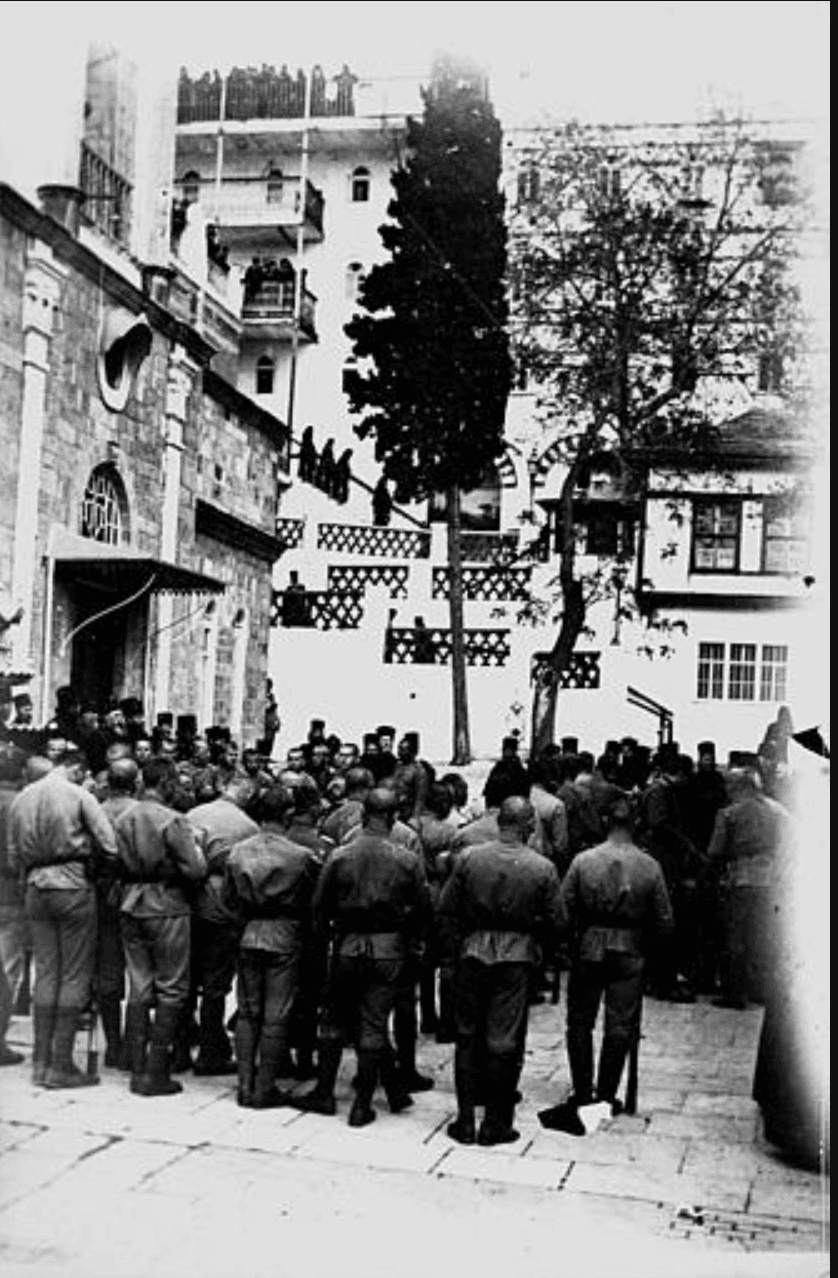
After the expulsion of the rebellious monks, Russian soldiers stand in front of the church. 1913..
”A survey organized by the archbishop showed that among 1,700 monks of the St. Panteleimon Monastery:
- 661 monks declared themselves as name-fighters,
- 517 monks as name-glorifiers,
- 360 monks refused to participate in the survey,
- and the rest declared themselves as neutral..
In May and June, Archbishop Nikon spoke with the name-glorifiers — heretics who believed that The Name of God is the same as God Himself — and tried to persuade them to voluntarily change their beliefs, but without success..
On July 31 the army stormed the monastery. Although the monks were unarmed and did not actively resist, the soldiers acted very roughly. They set up two machine guns and several water cannons, and the soldiers were ordered to beat the monks with bayonets and rifle butts..
Allegedly four monks were killed, and at least forty-eight were wounded..
After the assault on the St. Panteleimon Monastery, monks from the St. Andrew’s Skete voluntarily surrendered..
The military transport “Kherson“ was turned into a prison ship. It took 628 monks to Russia and on July 9 sailed for Odessa. Forty monks were left in the Athonite hospital because it was estimated they would not survive the transport..
On July 14, the steamer “Chikhachev“ brought from Mount Athos another 212 monks.. The remaining monks signed statements renouncing name-glorification..
After questioning in Odessa:
- 8 imprisoned monks were returned to Athos,
- 40 were imprisoned,
- and the rest were defrocked and exiled to various parts of the Russian Empire, according to their place of residence..
One of the leaders of the name-glorifiers, Antony Bulatovich, was sent to the family estate in the village of Lebedinka, in the Kharkov province, where many name-glorifiers later moved..”
Thus, after this military action, the number of Russian monks on Athos fell from 3,500 to 1,600, significantly reducing Russian influence. The story of heretical teaching was used to justify military intervention. The alleged division into “name-fighters” and “name-glorifiers” was used once again in history to implement political decisions by force..
Of course, Russia had more important strategic interests in the First World War, and the assessment was that it was better to make a compromise with the Greeks, English, and French regarding Mount Athos. However, a believer cannot help but wonder if God punished the Russian people for these actions? Four years later, the October Revolution begins, and the communists come to power in Russia..
French mission 1917.
This is not the end of the story. I found a few photographs in the French military archive when they were disarming the monasteries..
The French mission was tasked with supplying several monasteries on Mount Athos, on Halkidiki..
”Monks of the St. Panteleimon Monastery, which was then under snow, watching the first French ship bringing supplies from the exit of the dining room. Improvised supplies were necessary, so some soldiers even fished with grenades..”
It seems that it was agreed that the monasteries would hand over weapons in exchange for aid – food, medicine, and normalization of supplies. The archival comment with the pictures is as follows.:
”The mission seized 475 rifles, 441 bayonets, and 103,000 bullets from Mount Athos. The soldiers loaded them onto the ship “Buffle“ anchored in the port of St. Panteleimon, guarded by French-Russian troops..
The fathers of the monastery received the mission officers in the large salon of the monastery and then escorted them back to the ship..
Monasteries Xenophontos, Dochiariou and the Bulgarian monastery Zograf received the French mission and blessed the soldiers who came to help them..”
Of course, from such a polished statement, it is not easy to grasp the essence, which is that some monasteries were armed to the teeth and ready for serious conflicts. These pictures are evidence that it did not happen, but there was a real possibility that it could..
As before, this action was prepared in the background. Intelligence agents and diplomats agreed, and then the mission came to provide “assistance,” and the monastery handed over the weapons. In this way, everyone preserved their dignity, and there was no violent conquest and search of the monasteries..
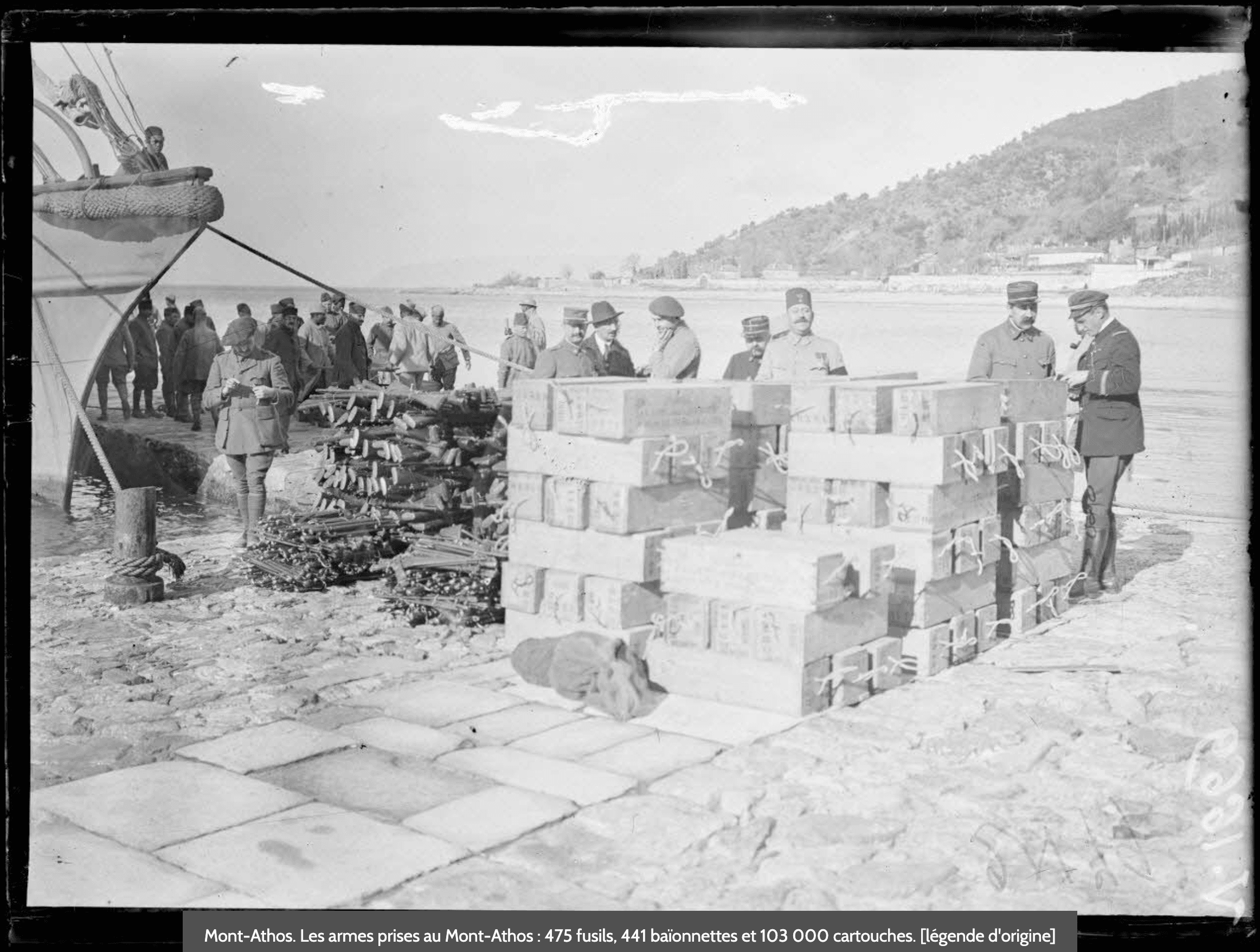
The mission seized 475 rifles, 441 bayonets, and 103,000 bullets from Mount Athos..
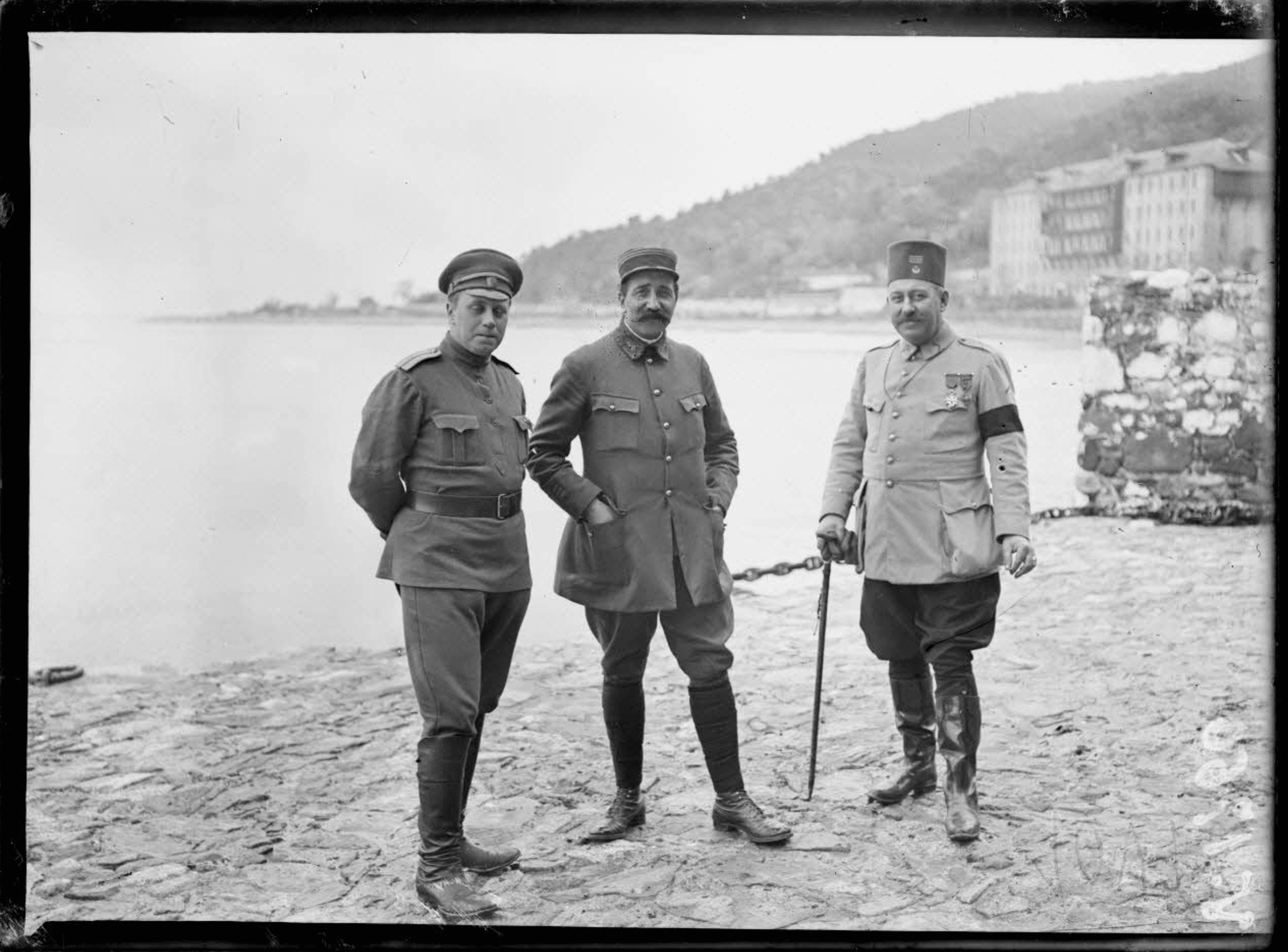
In this picture, we see the three heads of the mission – a Russian, a Frenchman, and a person in oriental attire. This indicates that it is all part of an agreed reduction of tensions..
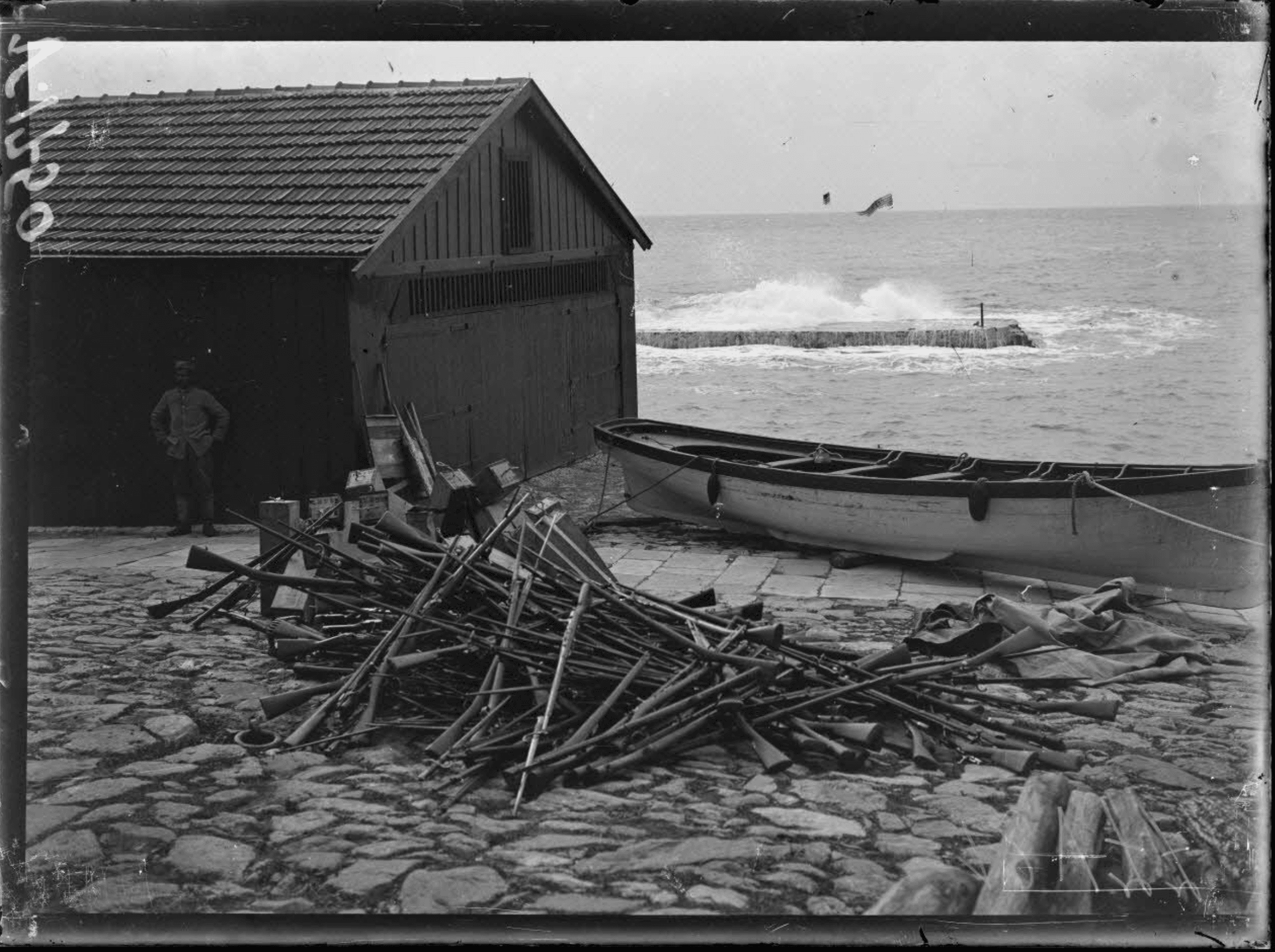
Part of the seized weapons..
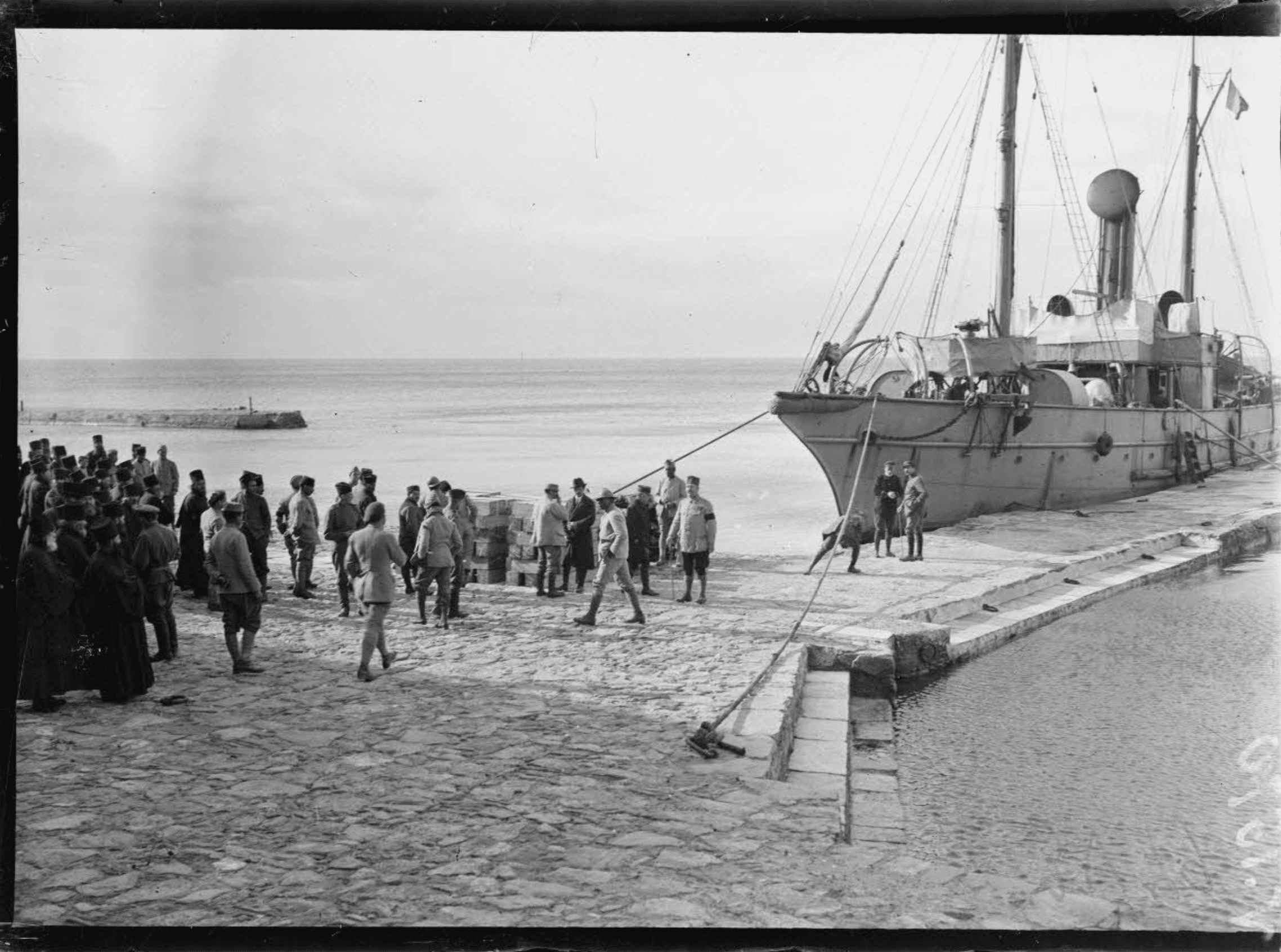
Two French ships were involved, “Buffle” and “La France.”
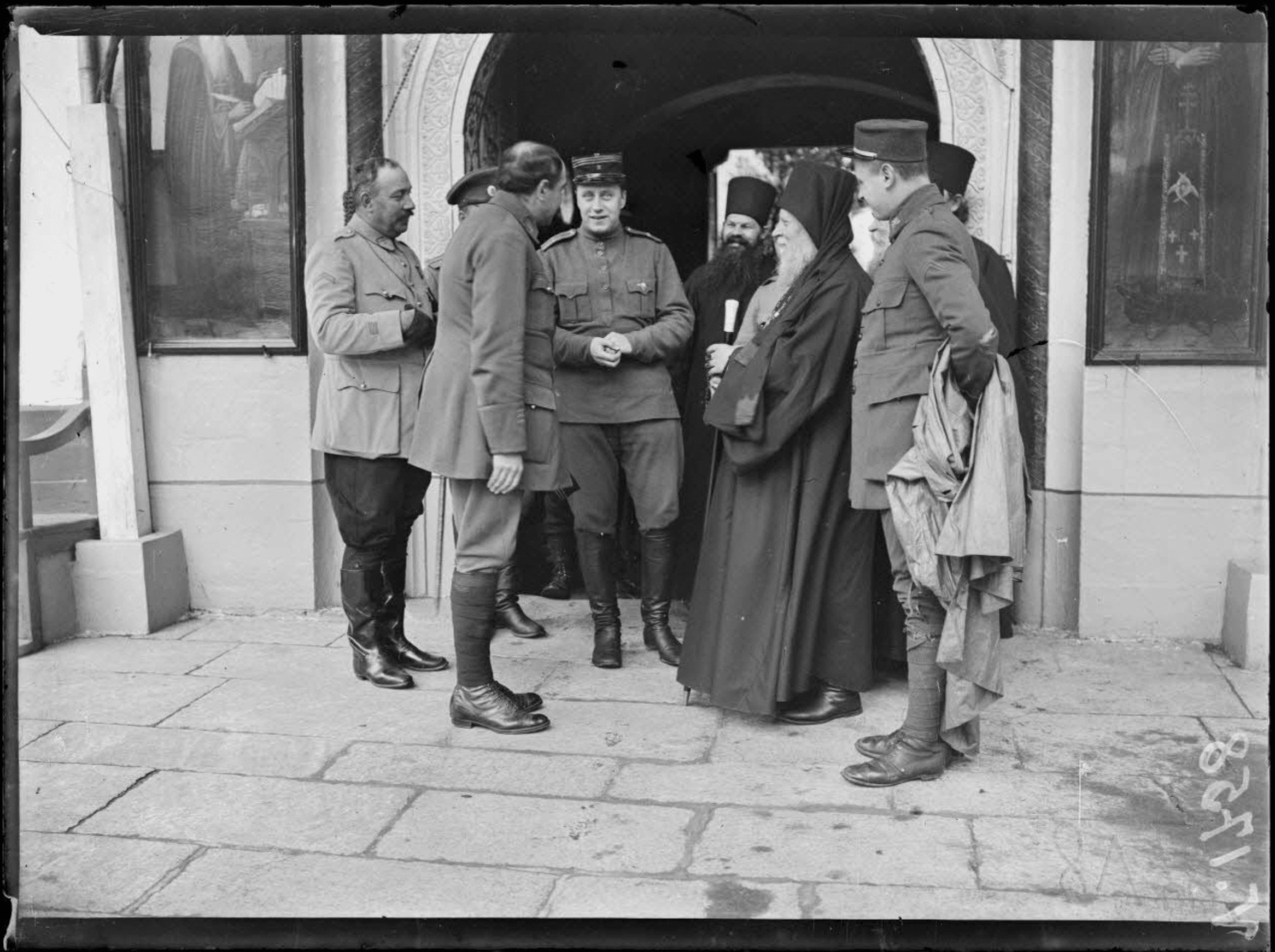
French soldiers with the elders of the Russian St. Panteleimon Monastery..
All this happens nine months before the October Revolution in Russia. Just a few days before this, Grigori Rasputin was killed in Russia. Tsar Nicholas II falls two months later in the February Revolution..
Conclusion
After the fall of the Turkish Empire in the Balkans, tensions rise, new states are formed, and this conflict is projected onto Mount Athos..
First, the Greeks occupied Mount Athos to take it from the Turks, then the Bulgarians sent their troops. The Russians had over 3,500 monks and were ready to fight, and documents show they were armed. However, the Serbs side with the Greeks., even the monks themselves participate in the military conflict against the Bulgarians..
In London, a compromise is reached regarding Mount Athos, which Russian diplomacy agrees to. Russian monasticism did not agree to the compromise, so in the end, under the pretext of fighting heretical teaching, the Russian army intervenes, displaces, and pacifies its monks. A few years later, the monks hand over their weapons to the allies, and hostilities cease..
Thus, Mount Athos became Greek territory..
Sources: