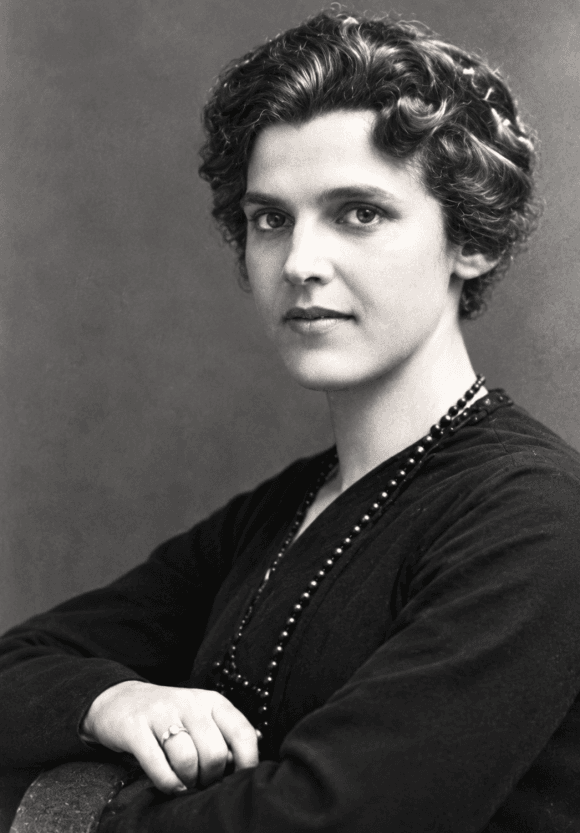
There are many lies and distortions in the story of Diana Budisavljević. We are told, for instance, that no one knows where her card index is. There is no mention of her family connection to Jovanka Broz, née Budisavljević. Nor is there any mention of officials of the Independent State of Croatia (NDH) from the Budisavljević family who later joined the Partisans. Diana’s husband was a doctor with connections close to Poglavnik Ante Pavelić, while his brother Srđan was the king’s representative who handed power to Tito. Much remains little known.
What is false here? Diana existed and did work on placing children with Catholic families. The Ustaša solution for the Serbs was to kill one third, expel one third and convert one third. She was part of that third component: conversion.
She was not formally a state employee or a member of the Ustaša, but she was close to the Catholic Church. Deliberately making a heroine of her serves to remove the stain from the Catholic Church and Caritas, and also helps the cause of Stepinac and his possible canonization. If the Diana story gains acceptance, it can later become a foundation for the claim that the Catholic Church was actually rescuing children.
That is why several books were published and a film was funded. Only 50 years later was her work presented as a private rescue operation. A light in a dark tunnel. But there was no light. Here I will explain why I think so.
Let us take this in order. Who was Diana’s husband?
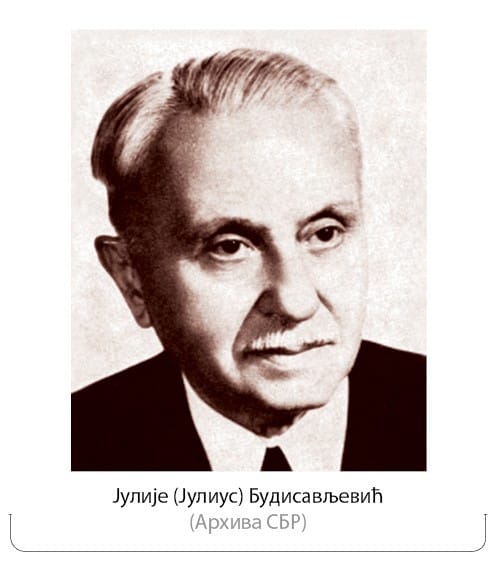
Diana’s husband — Julije Budisavljević (1882–1981)
A Serbian surgeon, professor at the Faculty of Medicine in Zagreb and husband of Diana Budisavljević.
There is an important detail that is rarely mentioned: Croatian biographical sources state that Julije was retired for political reasons in mid-1944 and reinstated as head of the surgical clinic after the liberation.
A connection to the Ustaša leadership: Mile Budak
I found the most interesting detail in a 2021 paper by Croatian historian Nikica Barić of the Croatian Institute of History.
Reports sent to the Yugoslav government-in-exile in late 1941 claim that Julije Budisavljević retained his position as head of the surgical clinic thanks to the intervention of Mile Budak, a senior Ustaša official.
The reason given in those reports is that Julije had saved Budak’s life through surgery several years earlier.
The Ustaša police granted him special protection in 1941
As a Serb, Julije was issued police document No. 298a. However, an order from the Ustaša Police Directorate dated July 10, 1941 instructed subordinate authorities not to apply to him the restrictions on movement imposed on Orthodox Serbs.
In other words, he was exempted from some of the measures affecting other Serbs in the NDH. This confirms his special position.
Julije converted from Orthodoxy to Catholicism in 1941
There is archival confirmation of this. In 2022, Croatian historian Jure Krišto published information from church documents:
- On July 16, 1941, Julije personally signed an application for himself and his daughter Jelka to be received into the Catholic Church.
- They were received into the Catholic Church on August 4, 1941.
Historians interpret the reasons differently. Barić considers it likely that conversion made Julije’s position in the NDH easier. Krišto also points to the family’s religious connections, but acknowledges that it is impossible to know how freely such a decision could have been made in those circumstances.
So the conversion to Catholicism is not a rumor: it is documented.
A secret police report from April 1944
Croatian State Archives — HR-HDA-1549, I-51/1181–1182, document dated April 25, 1944.
“He appears entirely loyal […] He is certainly not a sympathizer of the Ustaša movement, but does not express his convictions.”
This is my translation of part of the report quoted by Barić in his paper.
The police informant described Julije as a conscientious, hardworking and respected surgeon who was politically inactive, but also noted his relationship with his brother Srđan Budisavljević, a prominent Serbian politician.
This is the Ustaša police’s assessment, not an independent account of his beliefs. Still, it is significant that the report itself does not describe him as a supporter of the Ustaša movement. A few months later, in 1944, Julije was retired.
What exactly did he do for Diana’s operation?
Diana’s diary records that on October 26, 1941, Julije suggested contacting the architect Marko Vidaković, who subsequently became an important associate in helping persecuted Serbs.
Interestingly, after the war Julije and Marko Vidaković were proposed as defense witnesses at the trial of Alojzije Stepinac, but were not allowed to testify.
Testimony concerning Pavelić
On June 26, 1951, Julije Budisavljević was questioned as a witness in the criminal proceedings against Ante Pavelić before the District Court in Zagreb.
The archival reference is:
HR-HDA, fonds 421, box 123 — Record of the questioning of witness Prof. Dr. Julije Budisavljević in the case against Ante Pavelić.
What did he do during the war?
This part is missing from Wikipedia. You will notice that his Wikipedia biography skips the Second World War.
Barić quotes Julije’s statement from the 1951 record:
“At the time of the German occupation of our country in 1941, I was a professor at the Faculty of Medicine and head of the surgical clinic in Zagreb. […] I remained in active service as a professor until 1944, when I was retired.”
Did he treat Pavelić?
According to the sources located, Pavelić’s personal physician was Dr. Mile Budak (1903–1961), a specialist in pulmonary diseases, rather than Julije Budisavljević.
There were two different men named Mile Budak:
| Person | Who he was |
|---|---|
| Mile Budak (1889–1945) | Ustaša ideologue, minister and Pavelić’s deputy |
| Dr. Mile Budak (1903–1961) | Pulmonologist, nephew of the elder Budak and Pavelić’s personal physician |
Both appear in the Croatian Encyclopedia. The Croatian publication Express and a historical study by Tomislav Jonjić explicitly identify the younger Budak as Pavelić’s doctor.
Wartime diplomatic reports claim that Julije treated the elder Budak, the Ustaša deputy leader.
Julije did not suffer professional persecution after 1945
This is particularly interesting when compared with the story that the entire Budisavljević family was rejected after the war.
According to the Croatian Biographical Lexicon:
| Year | Julije’s position |
|---|---|
| 1944 | The NDH authorities retire him for political reasons. |
| 1945 | He returns to the surgical clinic in Zagreb. |
| 1946 | He continues working at the clinic after its relocation to Rebro. |
| 1953 | He retires in the normal course of his career. |
| 1968 | The University of Zagreb awards him an honorary doctorate in medical sciences. |
| 1981 | He dies in Innsbruck, in his 99th year. |
This shows that Julije retained considerable professional and social standing in socialist Yugoslavia. Unlike Diana, whose humanitarian operation did not receive adequate public recognition, he received university honors.
But where was Julije buried?
An article published by the Kompas portal on October 8, 2026 claims that Julije was buried in the Catholic Obexer family tomb in Innsbruck.
However, in a January 2025 report, RTS journalist Vesna Knežević explicitly states the opposite: after his death in 1981, Julije’s body was transferred from Innsbruck to Zagreb and buried at Mirogoj Cemetery.
She even specifies that he was buried in a separate grave near the main entrance, while the old Budisavljević family tomb stands beside the Orthodox Chapel of Saints Peter and Paul.
There are also photographs of the Budisavljević grave at Mirogoj in Croatian sources. I therefore consider the claim that Julije was buried in Innsbruck most likely mistaken.
To recap:
- Julije was a Serb, but as early as July 10, 1941 he received special police protection from measures restricting the movement of Serbs.
- Reports to the Yugoslav government in London mention protection by the Ustaša deputy leader Mile Budak, allegedly because Julije had previously operated on him.
- Julije applied to convert to Catholicism on July 16, 1941, and on August 4 he and Diana married again, this time in a Catholic ceremony.
- The NDH police report of April 25, 1944 describes him as loyal, but not a sympathizer of the Ustaša movement.
Diana Obexer Budisavljević
It is important to know that Diana worked with certain NDH institutions, representatives of the Catholic Church and Caritas. She was supposedly a Croatian Red Cross volunteer. The diary that appeared 50 years later claims that she worked on obtaining permits and placing children. Participants in the operation did not remember her as someone who stood out in transporting children or did anything particularly remarkable. She worked on a state project in 1942–1943 through which children were placed for adoption with Catholic families.
I believe that toward the end of the war Diana, like many other participants in the appalling events of that time, acquired paperwork to show that she had supposedly rescued children and thereby avoid arrest. An incomplete copy of the records could have served as a form of cover, since it was clear that the NDH would disappear and that the Red Army was approaching.
Here are some details on that subject.
Alongside Diana’s cards, the NDH maintained an official state card index
In mid-August 1942, Kamilo Brössler, an official of the NDH Ministry of Social Welfare, organized an official register of children. Diana used transport lists supplied by Brössler, while the ministry transcribed her handwritten information onto its official cards.
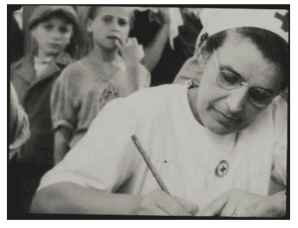
The claim that she simultaneously maintained a parallel card index has been taken out of context. Several copies of the index were made, and she supplemented it with information about the children, their origins, parents and placements for Caritas and the Catholic Church.
I found a joint explanation published in 2022 by Rajka Bućin, an archival adviser at the Croatian State Archives, and historian Nataša Mataušić.
They describe the procedure in August 1942:
- Brössler, the supervising official, supplied Diana with transport lists from the ministry.
- Diana sent Brössler information about individual children on unprinted slips of paper.
- The ministry transcribed that information onto official state cards.
- Information was therefore collected in parallel at two locations.
This means that the state card index was not simply a duplicate kept in Diana’s home. The NDH ministry created and used its own official records, which Diana helped compile.
Notice this: the NDH state maintained and used records of Serbian children. There were no computers or photocopiers at the time, so records were simply copied by hand or on a typewriter.
Another important discovery was made by the Museum of Genocide Victims in Belgrade in 2023: a list of approximately 5,800 Serbian children from 1942, connected with the Institute for Deaf-Mute Children in Zagreb. The museum emphasized that this was a primary institutional source, while Diana’s card index was secondary in relation to it.
An even more important distinction: 12,000 cards do not mean 12,000 rescued children
According to Bućin and Mataušić, Diana’s card index contained approximately 12,000 cards in 25 drawers in May 1945.
However, the children recorded included some who died after being taken out of the camps.
The claim that she personally rescued 12,000 children therefore cannot be accepted as an automatically established number of survivors.
History and film — where do they differ?
Barić shows that the film does not always match the diary itself. For example, the Ustaša police search of the family apartment is dramatized in the film, while the diary shows that Savo Besarović intervened with Eugen Dido Kvaternik and helped bring the search to an end without consequences. The film also changes the content of the conversation with Stepinac.
Nataša Mataušić and Rajka Bućin — an explanation of the origins and fate of the card indexes (2022)
December 16, 1941 — Diana speaks personally with Andrija Artuković
Savo Besarović arranged her meeting with the Ustaša minister of the interior. Only a few days earlier, Besarović himself had had an audience with Pavelić. According to her account (pp. 20–21), Artuković verbally approved her humanitarian work but gave her no written authorization.
I have deliberately set out all these details so that Diana is not left looking like a kindly soul operating in secret. Like her husband, she was well connected to the very top of the NDH, as well as to the Catholic Church and Caritas.
What does Serbian historian Milan Koljanin say?
I also found Milan Koljanin’s 2007 paper, which is particularly useful because it does not rely on the later cinematic portrayal of Diana. He confirms that the records were created partly at the request of NDH ministry officials, but also documents the group’s independent work.
According to his research, Diana and her associates sent food and medicine to prisoners, helped organize transports of children, sought information from parents sent to forced labor and helped reconnect them with their children.
Koljanin also mentions the disturbing fact that some children were exploited for labor by their foster carers, which was reported to the authorities. Placing a child with a family did not in itself mean that the child was safe: some children were used as slaves.
The Catholic Church and Caritas work on conversions to Catholicism
Krišto’s paper is even more interesting. He argues that Diana underestimated the role of Stepinac and Caritas while overstating her own.
An important detail: on August 23, 1942, a decision was made to organize the placement of children on a large scale through the network of Catholic parishes and Caritas. According to the diary, approximately 5,000 Orthodox children were placed with families from Zagreb in this way.
Here is something particularly interesting: Krišto quotes a diary entry of February 18, 1943 stating that Pavelić had ordered that care be provided for refugee children, while Caritas requested permission from the Ministry of the Interior to arrange their placements. Diana was a participant in this operation.
The NDH state therefore knew about these arrangements and participated in issuing permits. This matters for understanding the entire operation.
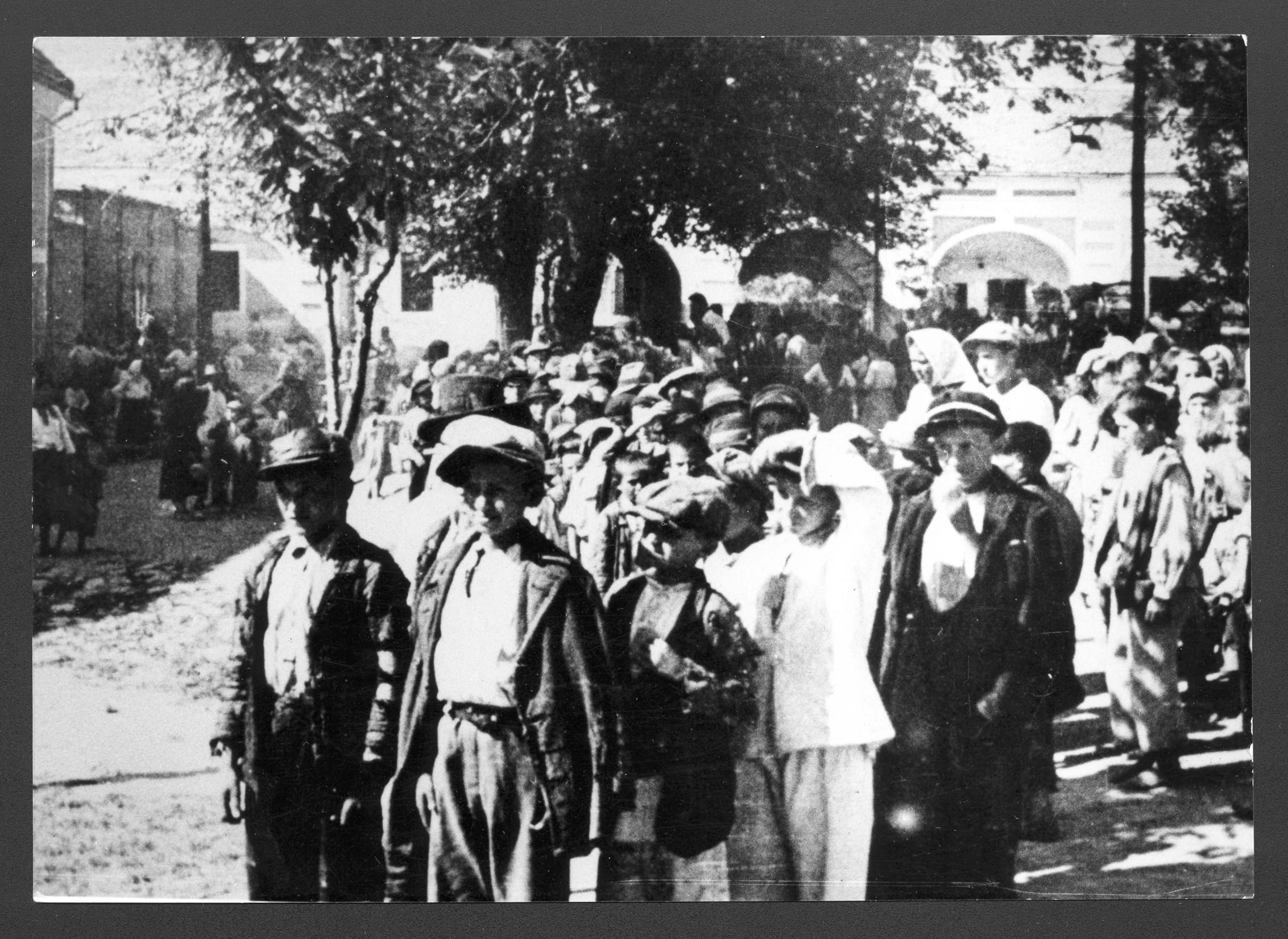
These details make painful reading because they contain so many lies and distortions. For example, Caritas is said to have established a fund called “Dijete k majci” [Child to Mother]. Diana’s group reportedly supplied an initial 100,000 kuna and 100 pairs of shoes so that poor mothers who had lost their homes could live with their children again.
Reading that, one might think: “How kind and humanitarian.” But the reality is that the state killed large numbers of people, burned villages and abducted children, and then ordered that some of those children be placed with Catholics or returned to their mothers. Aid went to 2,500 surviving mothers, and we do not know whether they had been forced to convert to Catholicism because, imagine that, they had no homes or shoes. Of course they had no homes: their houses had been burned down and they had been driven from their villages.
On the strength of this “rescuing children” and “helping mothers,” many escaped prison after the war, while some remained in office. We will also see that certain Ustaša connections reached all the way to Tito.
What about the argument that the operation served conversions to Catholicism?
The conversion of Serbs to Catholicism was an actual NDH policy. It is therefore reasonable to ask whether placing Serbian children with Catholic families could also have served assimilation.
Especially when we know that Caritas and Catholic parishes participated in these placements with permission from state institutions.
Nevertheless, we must distinguish four different outcomes:
- a child was taken out of a camp;
- a child survived;
- a child was placed with a Catholic family;
- a child was formally converted to Catholicism or had their identity changed.
The US Holocaust Memorial Museum confirms the baptism of children. In the third volume of the Encyclopedia of Camps and Ghettos, 1933–1945, published in 2018 by the United States Holocaust Memorial Museum, historian Joseph Robert White discusses the children’s camp at Sisak.
On page 74, he explicitly states that many children ended up in foster care and that many were baptized into the Roman Catholic Church, either because of the NDH’s policy of forced conversion or for practical reasons.
This confirms that baptism is not merely an assumption based on the children’s placement with Catholic families.
The official website of the Jasenovac Memorial Site contains an important statement about the camps at Jastrebarsko and Gornja Reka:
“A characteristic of these children’s camps was the re-education of children who were predominantly Orthodox.”
The same museum states that Caritas took responsibility for approximately 500 children from Jastrebarsko, while 1,637 boys and girls were placed with families in Zagreb, Jastrebarsko and the surrounding area.
Could the regime have used the operation to present itself as humanitarian?
That is a legitimate research hypothesis. The Ustaša authorities issued transport permits, maintained records and controlled placements. Some institutions and officials of the regime could later have highlighted their role in providing care.
Here is another interesting detail. Diana is usually described as a volunteer or as working for the Red Cross. My research, however, shows that even this point is not entirely clear. The diary contains several important entries:
- August 19, 1942. Brössler offers her the task of organizing and running a reception station at Josipovac in the name of the Red Cross.
- August 26, 1942. Red Cross director Hühn objects to her working for the Red Cross and rejects her requests.
- February 1944. The same director allows her operation to act under the Red Cross name when necessary.
- As late as August 13, 1945, she is invited to work with the newly established city Red Cross, but declines.
Diana records that in August 1942 the NDH ministry paid the Red Cross nurses at the reception center. The state therefore directly funded some personnel costs.
A chronology — what happened and when
August 1942 — the systematic card index begins
At Kamilo Brössler’s initiative, the registration of children brought from the camps begins. The information is used both for official NDH records and for Diana’s parallel card index.
Winter 1944/1945 — preparations to trace parents
Toward the end of the war, Diana and her associates compare transport lists, names, photographs and information about foster carers. They make a particular effort to identify young children registered without names.
May 9, 1945 — parents arrive looking for their children
After the liberation of Zagreb, according to the diary, increasing numbers of parents and members of the Yugoslav Army come to Diana to ask about their children.
May 24–25, 1945 — the first specific case of a child being found
An Orthodox mother comes looking for her child. Diana gives her information about the foster carers. The next day, the mother returns with the child and the woman who had been caring for it. Diana directs them to the ministry for the formal handover.
May 25, 1945 — the photographs are confiscated
Two men, whom Diana identifies in her notes as members of OZNA, the security service, take the albums of children’s photographs. A copy of the card index is taken from her associate Ivanka Džakula the same day.
May 28, 1945 — the main card index is confiscated
Acting on a written order from Tatjana Marinić of the Ministry of Social Policy, official Dragutin Madžer takes possession of Diana’s card index, notebooks and supporting documentation.
July 26, 1945 — problems with the records
According to Diana’s later entry, a meeting with Brössler establishes that the card index is no longer being handled properly.
August 13, 1945 — Diana is no longer allowed to work on the card index
She records that mothers returning from Germany still come to her, but she has to direct them to the ministry.
A small number of children were thus reunited with their parents after the war. However, this happened only after the liberation of Zagreb.
What was happening at the front in February, March and April 1945?
A military chronology immediately before the fall of the NDH
| February 1945 | The Red Army captures Budapest on February 13. German and Ustaša forces still hold Zagreb and much of the western NDH. Yugoslav units hold positions on the Srem Front and fight in Bosnia. Germany is already in a difficult strategic position. |
| March 1945 | The German offensive near Lake Balaton in western Hungary fails. The Red Army launches its offensive toward Vienna on March 28. On March 20, the Yugoslav Fourth Army breaks through German defenses in Lika. The final operation to liberate the country has begun. |
| April 6–14 | Sarajevo is liberated on April 6. The Srem Front is broken through on April 12, while the Yugoslav Third Army crosses the Drava. Soviet forces capture Vienna on April 13. Osijek is liberated on April 14. |
| April 20–30 | The Yugoslav Army directs its offensive toward Zagreb, Karlovac and Podravina. Fighting begins for the final defensive lines of the western NDH. Berlin is encircled on April 25; on April 30 Hitler commits suicide, and Yugoslav Army units enter Jasenovac. |
| May 6–8 | Pavelić leaves Zagreb on May 6. Karlovac is liberated on May 7 and Zagreb on May 8. |
As we can see, in February, March, April and May, both Diana and Caritas were well aware of what was happening and that the end of the NDH was near. It was also clear that surviving mothers would look for their children.
The first specific reference to children being returned comes toward the end of the war: on April 9, 1944, “Diana’s Diary” mentions two mothers who came for their children, but we have no other evidence.
The case of two mothers, April 7–9, 1944
According to Diana’s published diary:
- On April 7, 1944, two Serbian women were returned from a German forced-labor camp in Leverkusen. Their homes near Dubica had been destroyed, and their children had been placed with foster families through Caritas.
- On April 9, 1944, Diana gave them written recommendations for Catholic priests in the places where their children were living.
- In the same entry, she says that she was later informed that both foster carers had also taken in the mothers, thus reuniting the families.
As the entry shows, Catholic priests provided the contact for tracing the children. The mothers’ names were not recorded.
During the war, then, we find occasional references to providing parents with help and information, but no proven return of children to their parents. I conclude that Diana did not actually take a direct part in returning children, but registered them for the records.
The only specific mention of children being returned before the end of the war is this case of the two mothers, if it happened at all. There were several cases of children being returned immediately after the war, but only after the collapse of the NDH. The actual operation of returning children was carried out by the new state apparatus (99%).
In May 1945, Diana and her associates could reasonably have expected the new authorities to examine their contacts with Ustaša and German officials. It is therefore historically legitimate to investigate when their reports were compiled and whether they emphasized humanitarian work to explain those contacts.
What happened to the card index after its confiscation?
I also found an archival trail showing where the card index “disappeared.”
- May 28, 1945. — Official records state that the documentation was taken over and deposited in the Social Protection Section at Dukljaninova 3/I, Zagreb, for official use. We therefore know the exact address to which it was delivered.
- Summer 1945 – early 1946. — There is evidence that the new authorities consolidated several card indexes. Tatjana Marinić later stated that the collected records covered approximately 30,000 children and that a special office spent several months tracing surviving parents and returning their children. This is her account of the institution’s work, not a list of proven reunifications.
- August 30 – October 1, 1945. — Diana manages to recover two notebooks containing copies of the card index previously held by the Archdiocese of Zagreb. However, on October 1 she herself records that they contain only a small part of the subsequently expanded index.
- December 15, 1949. — I discovered another important date: the official register recording receipt of the card index bears a stamp reading “WEEDED OUT” with this date. However, that stamp on the register does not prove that the card index itself was destroyed at that time. Its later fate has not been reliably established.
- 1987. — The Croatian State Archives takes over another extensive state card index containing wartime and postwar information. It is not identical to Diana’s personal index, but includes many of the same names.
Where was the confiscated card index kept?
Nataša Mataušić’s book provides very precise information:
Ministry of Social Welfare — May 28, 1945.
Storage location — Social Protection Section, Dukljaninova 3/I, Zagreb.
The document is signed by Professor Kamilo Brössler as head of the department.
Archival reference HR-HDA-296 — Incoming Correspondence Register.
How many children did Diana rescue, and when?
Diana lost control of the card index only twenty days after the liberation of Zagreb. State institutions then continued the postwar reunification of families. We do not know exactly how many children were returned to their mothers with the help of her original card index before its trail was lost.
The source that reconstructs the fate of the index in greatest detail: Nataša Mataušić — Diana Budisavljević, chapter “How Diana’s Card Index Disappeared,” pp. 257–262
We have therefore established that Diana’s card index was confiscated and that a larger state index already existed. The museum in Belgrade confirmed that her index was secondary and that another, more detailed one already existed.
We also see that the Yugoslav state was responsible for returning children after the war.
When, then, did Diana rescue the children?
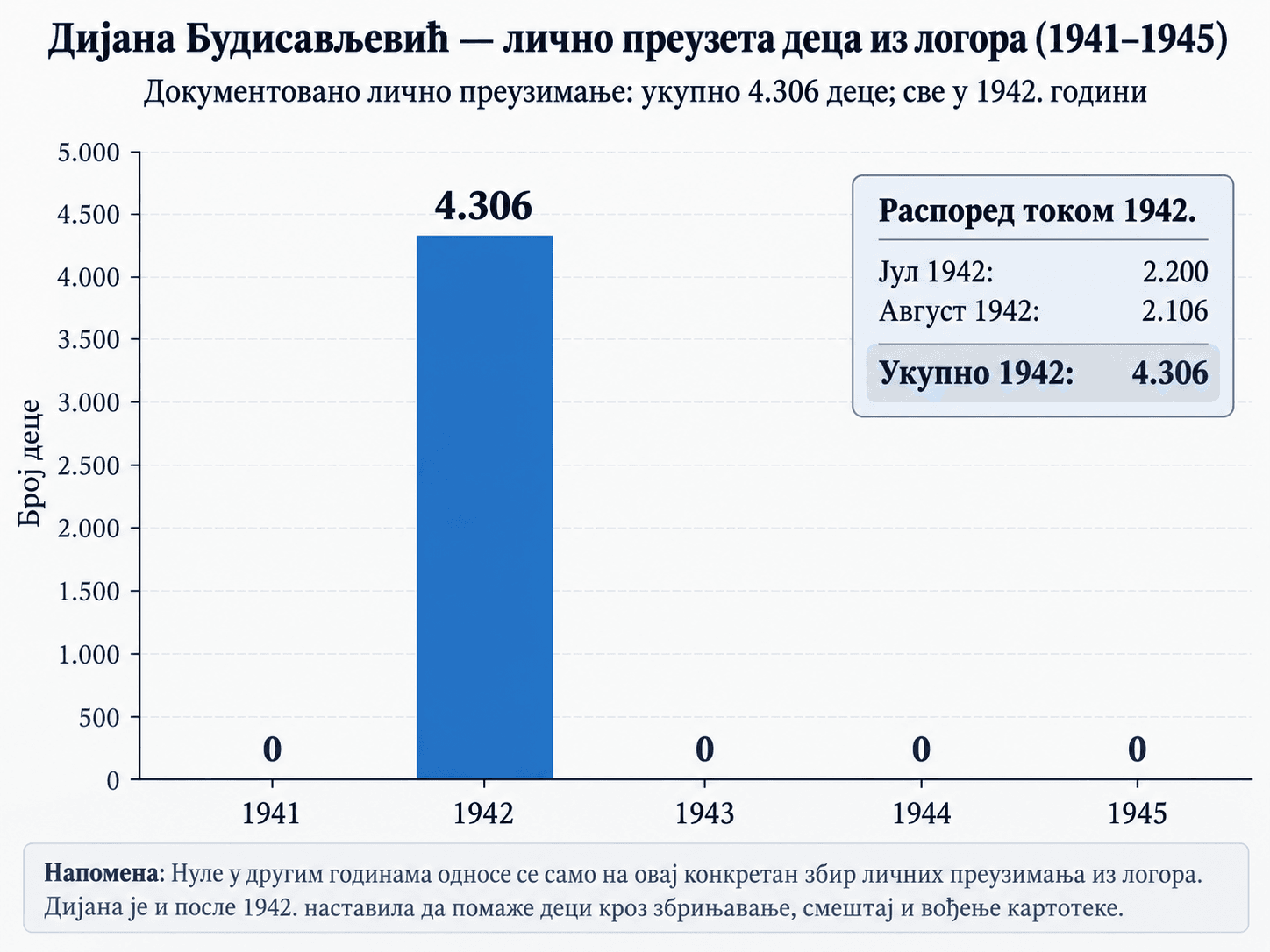
As we can see, Diana’s operation actually took place in 1942, specifically after the fighting on Kozara. She personally participated in taking 4,306 children out of the camps during 1942. In the other war years, her “operation” amounted to placing those children with Catholic families.
The question arises: why did Diana not rescue children in the following years — 1943, 1944 and 1945? The answer is simple: only in 1942 did the NDH issue that order and engage its social services. There were no subsequent orders concerning the transport of children out of the camps. That is where the story of some personal, secret operation by Diana comes to an end.
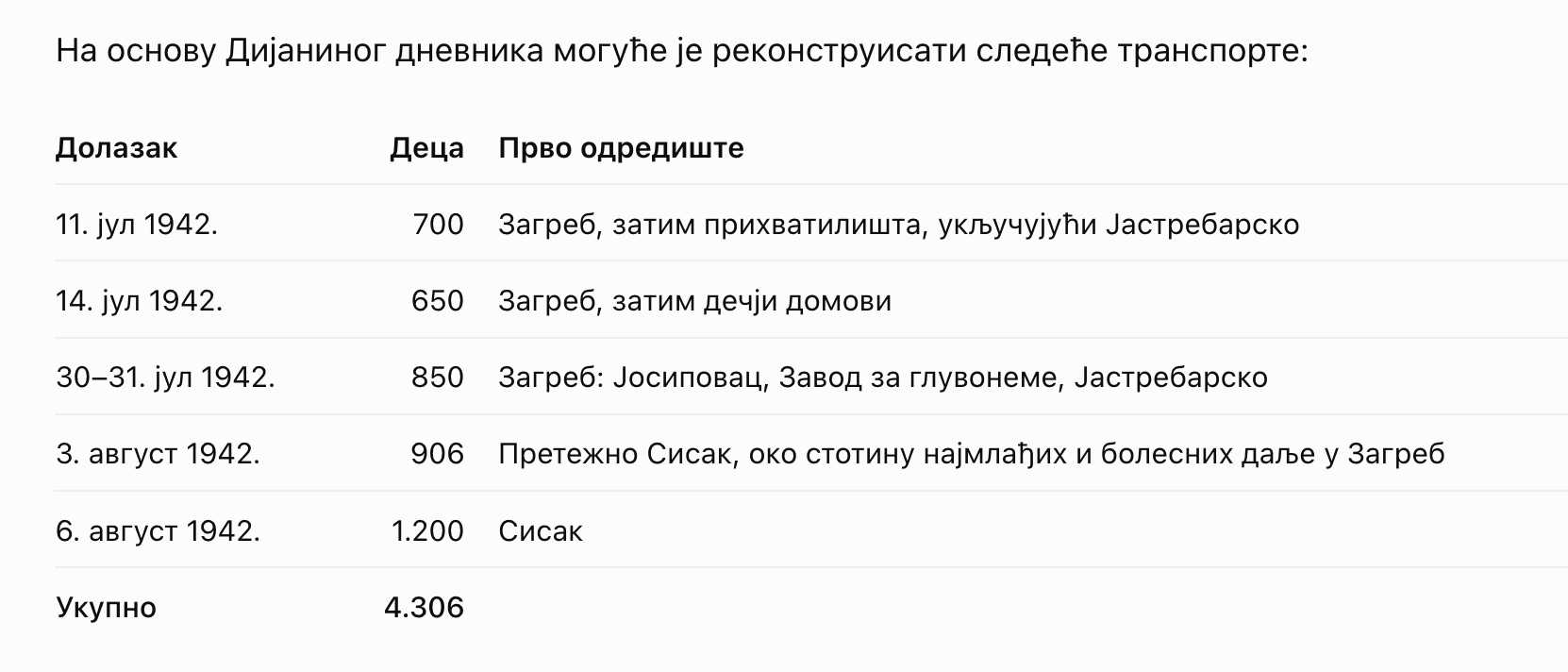
Five transports in total: the first two from Stara Gradiška, the third from Jablanac, the fourth from Jablanac and Mlaka, and the fifth from Mlaka and Košutarica. Interestingly, the leader of the first team, who headed the first two transports, was Vladimir Broz. We will return to this detail later.
All the other figures — 7,000 children and a total of 12,000 in the card index — do not refer to transports that Diana personally accompanied. They concern the total number of children from different transports, placed in various institutions, for whom she officially maintained records.
Her diary does not allow us to establish what happened to those children. Based on general documentation and later academic studies, we may assume that approximately half died of disease and malnutrition. An undetermined number were placed with Catholic families, and the rest in children’s homes.
People speak of “Diana’s children.” But the truth is that Diana actually maintained documentation for the NDH Ministry of Social Welfare, as well as a parallel register from which she supplied information to the Red Cross.
In her entry of August 14, 1942, she states that Kamilo Brössler asked her to compile a card index for the ministry as well. For example, she recorded that on July 28, 1943 she gave the Red Cross information on approximately 1,500 children. Here is an accompanying document that confirms her engagement by the Red Cross:
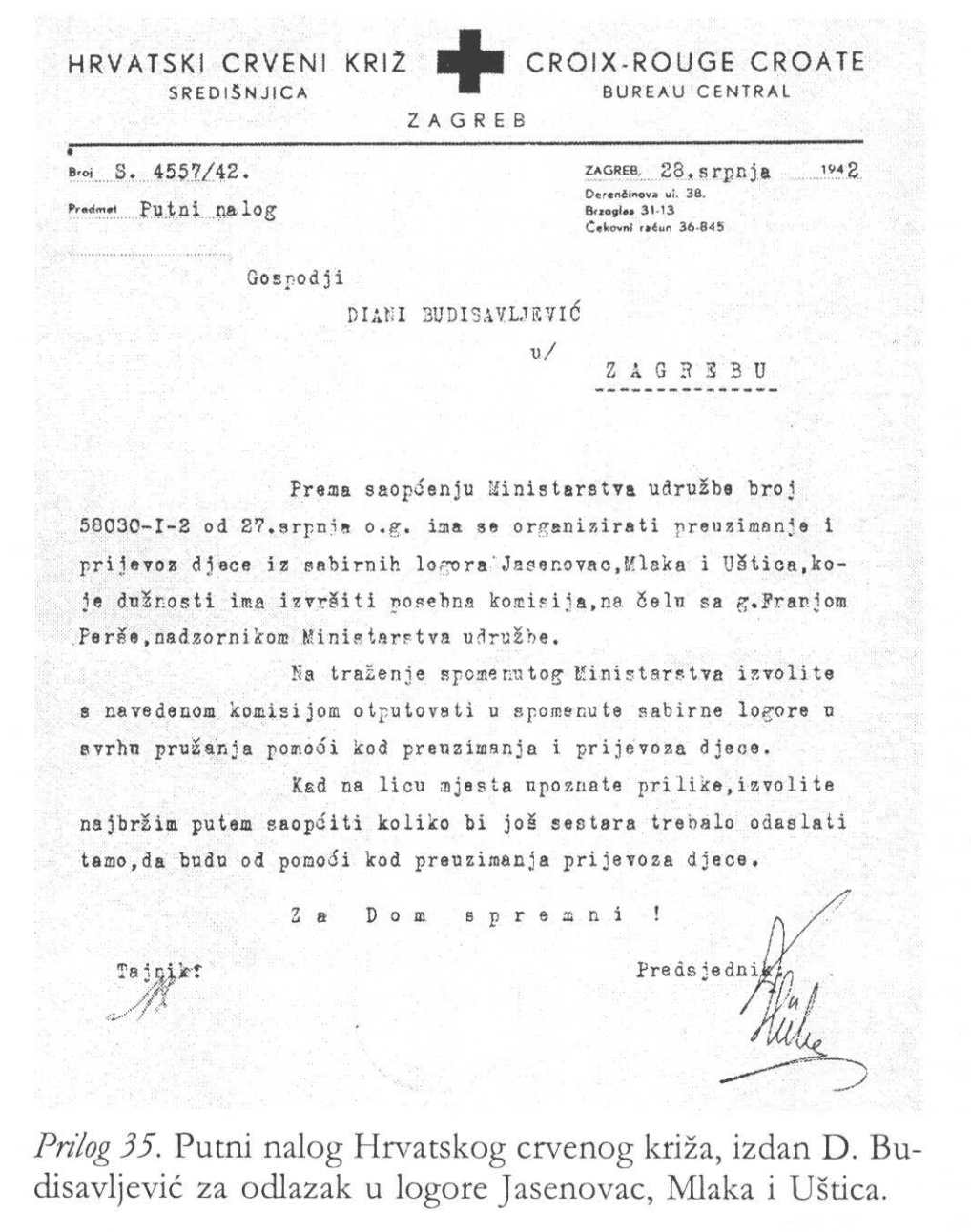
She also worked with the Jewish Community in Zagreb, which supplied her with aid for Jews in the camps. During the five transports of children from the camps that she accompanied, the commission was led by Vladimir Broz and France Perša, both NDH officials.
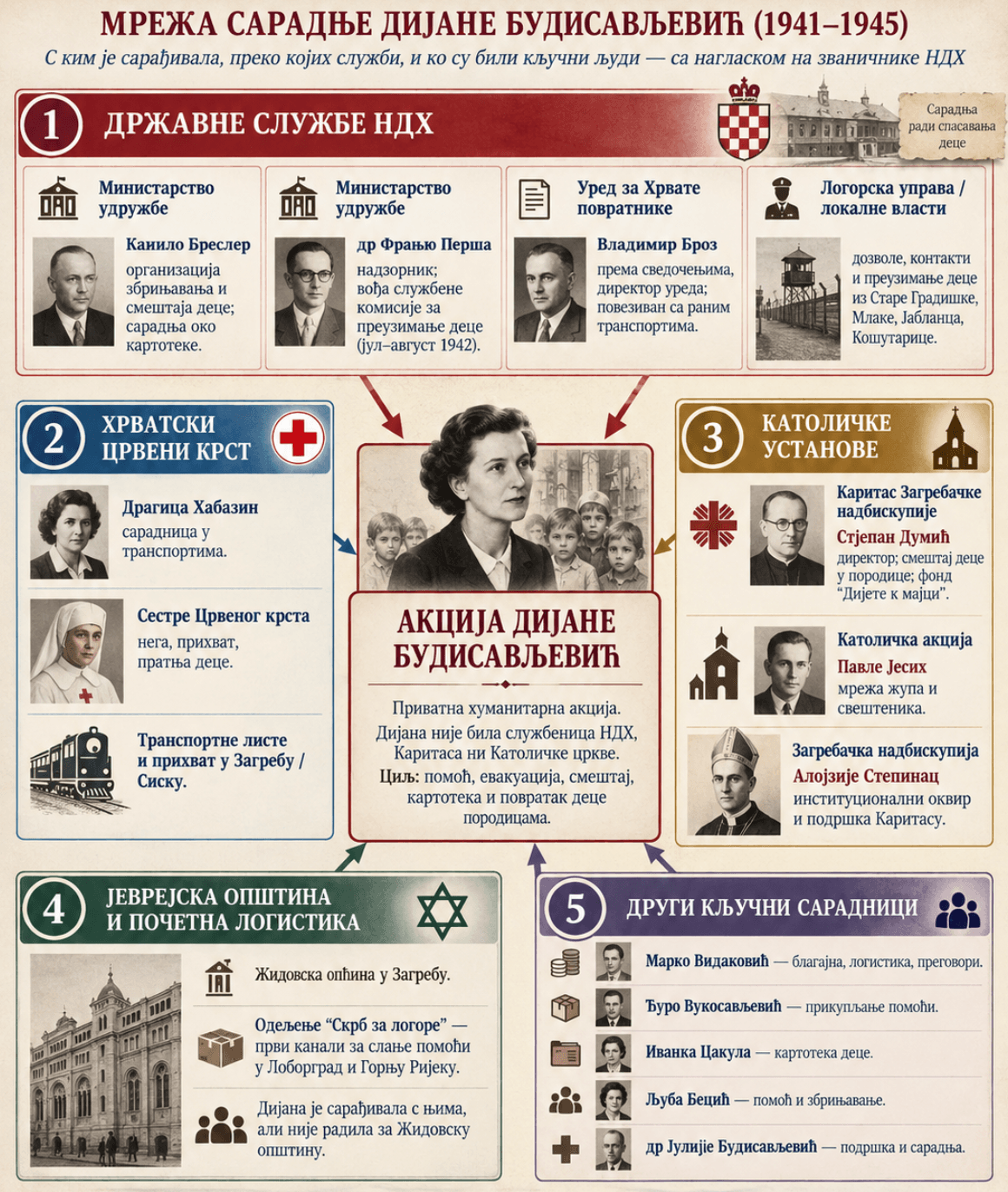
This leads us to conclude that Diana acted in accordance with NDH decisions, worked with the Catholic Church and Caritas (the Catholic humanitarian organization), and was in fact assigned to accompany transports and maintain records of abducted children, although she was formally a volunteer.
It is very likely that toward the end of the war she became worried about her own fate, since she was, after all, part of a serious criminal group. Her card index was initially maintained for the state. However, when she realized what crimes were involved and that these state documents would sooner or later be taken from her, she began copying the index. From that index she supplied information to the Catholic Church, Caritas and the Red Cross, and it could also have served as cover for a later defense.
One question remains: why did OZNA not arrest Diana when it confiscated her card index? She was directly involved in the operations of the NDH and the Catholic Church, yet apparently was not considered suspect. Why?
The Budisavljević family’s connection to Tito
Srđan Budisavljević — the man who gave Tito the mandate
Srđan Budisavljević (1883–1968), Julije Budisavljević’s brother
A Serbian politician from Croatia, lawyer, minister in the Kingdom of Yugoslavia and president of the Independent Democratic Party. During the war, he served in Yugoslav governments-in-exile.
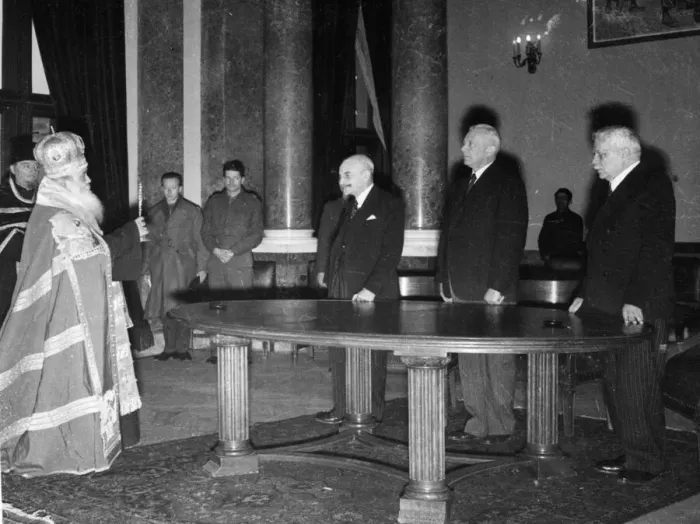
On March 5, 1945, Dr. Srđan Budisavljević, Ante Mandić and Dušan Sernec, the newly appointed regents of the Kingdom of Yugoslavia, took their oath at a ceremony in the Green Room of the National Assembly building in Belgrade, while King Peter II remained in exile.
Here are the precise dates:
- March 2, 1945. — King Peter II appoints Srđan Budisavljević, Ante Mandić and Dušan Sernec as royal regents as part of the Tito–Šubašić agreement.
- March 5, 1945. — The Regency assumes royal powers. The existing Yugoslav governments resign.
- March 7, 1945. — A new unified government is formed, headed by Josip Broz Tito.
- November 29, 1945. — The monarchy is abolished and a republic proclaimed. Srđan’s office ends.
This is not based solely on later biographies. On March 21, 1945, the US State Department officially confirmed the composition of the Regency and the formation of Tito’s government.
Original US diplomatic document, March 21, 1945
Although he held one of the highest formal offices during the transition in 1945, he withdrew after the abolition of the monarchy and lived in Zagreb. He received two decorations: the Order of Labor, First Class, and the Order of Merit for the People, First Class. In 1958, he published the book Stvaranje države Srba, Hrvata i Slovenaca [The Creation of the State of Serbs, Croats and Slovenes].
He did not continue as a minister or join Tito’s party leadership. He lived in Zagreb until his death on February 20, 1968. Srđan retired from politics in 1945, but Jovanka Broz and Stevo Krajačić attended his funeral in 1968.
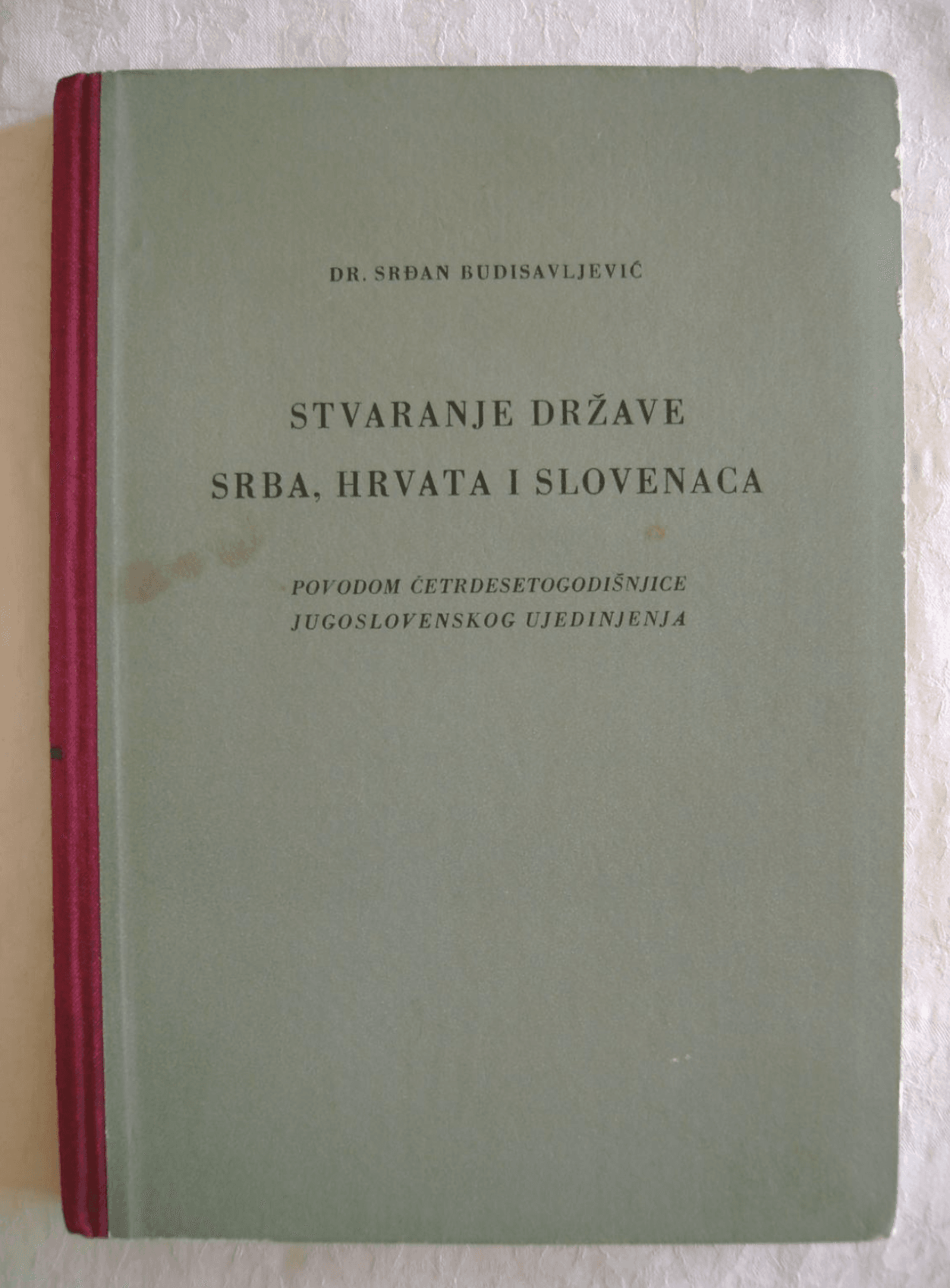
Srđan Budisavljević’s book
Tito personally received Diana and Julije in 1969
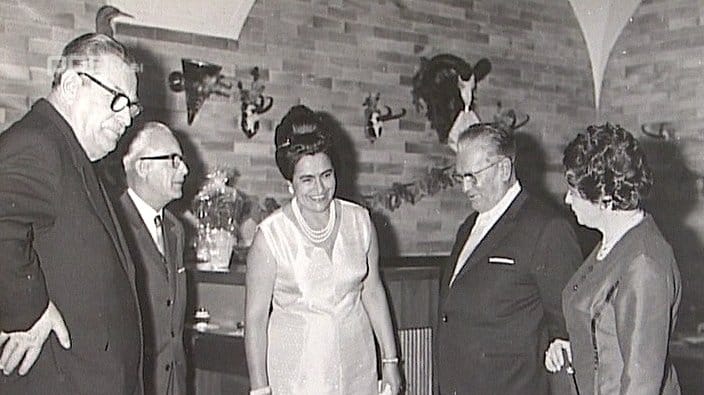
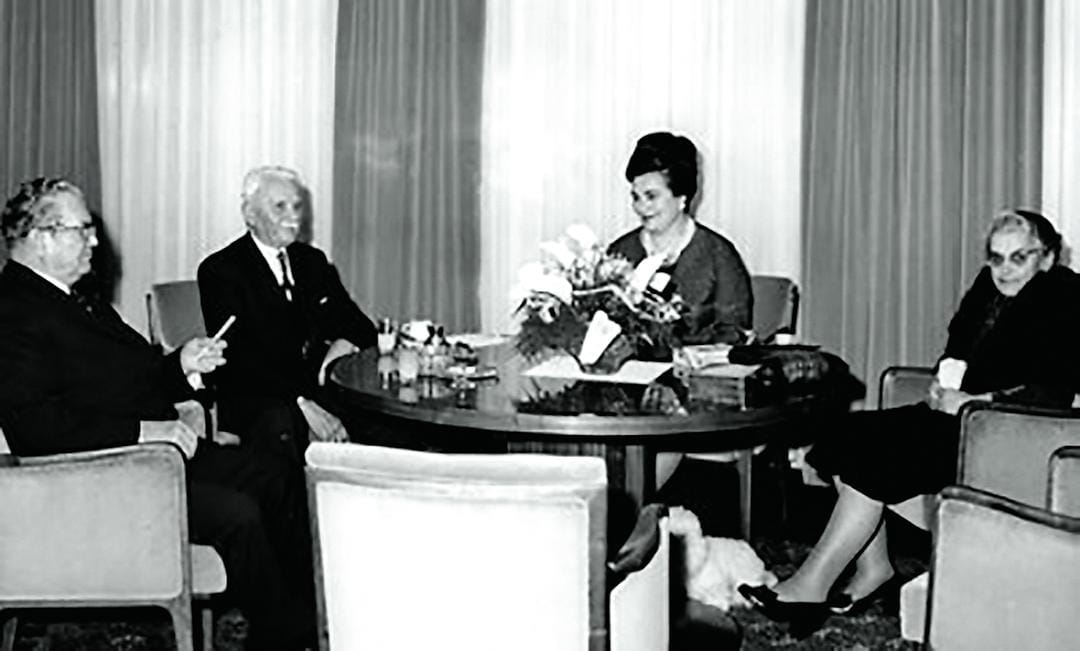
On December 19, 1969, at Villa Zagorje in Zagreb’s Pantovčak district, Josip Broz Tito and his wife Jovanka hosted a private reception for Diana and Julije.
The archival photograph is catalogued as a “meeting with the Budisavljević family.” Mataušić notes that, according to a later account, an official car collected the couple from their Zagreb apartment.
Jovanka Broz, née Budisavljević — related to Julije and Srđan
Jovanka Broz, née Budisavljević, was a distant relative of Julije’s family, although this source does not establish the precise degree of kinship. An article in Jutarnji list reproduces a text stating:
“From these sparse details one might conclude that Jovanka Broz, née Budisavljević, introduced some of her Zagreb relatives to Tito.”
Jovanka Broz at Srđan Budisavljević’s funeral with Diana and Julije
“It is even more likely that Jovanka Budisavljević herself knew more or less everything. She must have met her distant Zagreb relatives at least once before, just a year earlier, at Zagreb’s Mirogoj Cemetery, when Julije’s brother Srđan, much better known in political circles, was buried.”
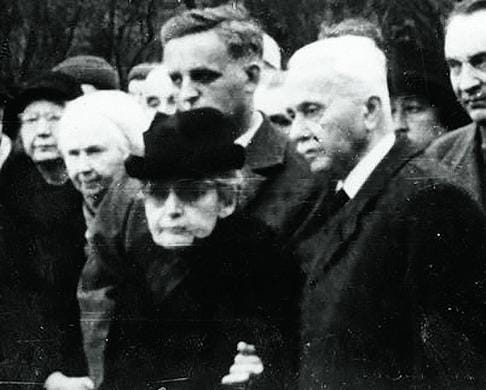
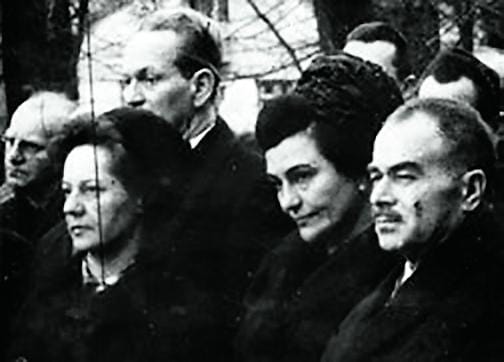
“On that cold winter day, his body was laid in the Budisavljević family tomb. Apart from family members, including his brother Julije and Diana Budisavljević, the funeral of this non-communist politician, who had not participated in politics for 23 years, was attended by members of the very top of the League of Communists of Croatia and Tito’s wife Jovanka Broz. Also present were the president of the Croatian government and future president of the Croatian party’s Central Committee, Savka Dabčević-Kučar, and the head of the Croatian UDBA security service, one of the most powerful men in Croatia and a close associate of Tito, Ivan Stevo Krajačić,” Mataušić writes.
However, Jovanka Broz probably also learned about Diana Budisavljević’s humanitarian work from Vera Becić-Velebit, wife of Tito’s foremost diplomat, Vladimir Velebit. Vera’s mother Ljubica, wife of the painter Vladimir Becić, was one of Diana’s closest associates in the operation to rescue and place Serbian war orphans. She even adopted a girl who had lost her parents in the Kozara tragedy. Vera Velebit herself also helped Diana.
She was very close to Jovanka Broz, whom they hosted in Rome in 1953, when Vladimir Velebit was the Yugoslav ambassador there. Jovanka, then still Budisavljević, had been sent to Rome to spend some time before marrying Tito in an established middle-class household, where good, “refined” manners were part of family upbringing and everyday life.
There is also this detail: on December 24, 1942, Ljubica (the mother of Vladimir Velebit’s wife) attended a Caritas Christmas celebration together with Diana, Julije Budisavljević and the Bojanić family. Archbishop Stepinac was also present and distributed parcels to the children.
Now remember my argument: Diana’s biography would be romanticized 30 years after her death and later used to revise the account of what Stepinac had done. Ultimately, he would be portrayed as the man directing everything behind the scenes.
Diana’s connections to the Ustaša and the Partisans
Since the underground Partisan movement itself was doing all it could to help these unfortunate children, it was not prepared to share the credit with a foreign woman who obtained permits from the Ustaša authorities “by who knows what means.” Her contacts with numerous German military and civilian officials already made her suspect as a collaborationist working with the occupiers.
Tatjana Marinić, a prewar Party member, had herself participated in rescuing children from the camps before joining the Partisans. When she returned to Zagreb with the Partisan victory in 1945, as a representative of the social welfare administration, she ordered the confiscation of Diana’s card index and the children’s photographs.
Even that was not enough. She personally removed statements about Diana Budisavljević’s role from the accounts of key witnesses.
Official credit for rescuing so many children — not only those left without care after the Partisan defeat on Kozara — was taken by the underground Partisan movement and by Tatjana Marinić personally.
I must point out here that people who worked on taking children away under Pavelić continued, after the arrival of the Partisans, to work on their supposed return. I mean Diana, Tatjana Marinić and Brössler alike. Diana and Julije met with the Brozes, while Tatjana and Brössler continued working in social institutions.
What did Tatjana Marinić write about Caritas and the Catholic nuns?
Tatjana Marinić worked in the camp with Brössler, Diana and others. She participated in transporting children from Stara Gradiška and knew very well who had done what, having worked alongside them for a time. She joined the Partisans in September 1943.
As early as November 15 and 16, 1944, while in the Partisan movement, Tatjana Marinić gave testimony about conditions in Jastrebarsko.
She made serious accusations against the Catholic nuns who ran the reception center, including withholding food from children, mistreatment and other forms of abuse.
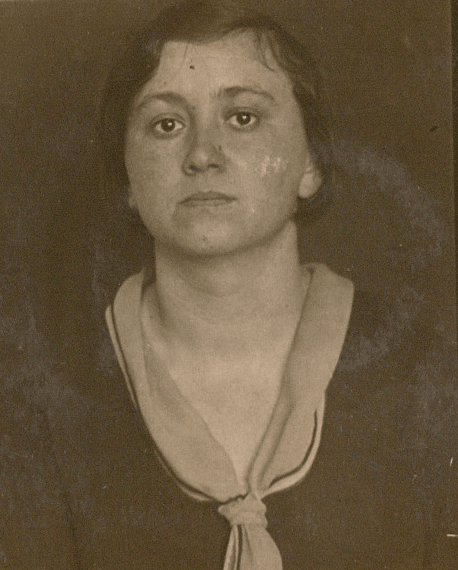
Kamilo Brössler and some doctors who worked with the children disputed her allegations about particular acts. At the same time, the children’s terrible suffering within the NDH system is beyond dispute; the responsibility of specific individuals must be examined separately.
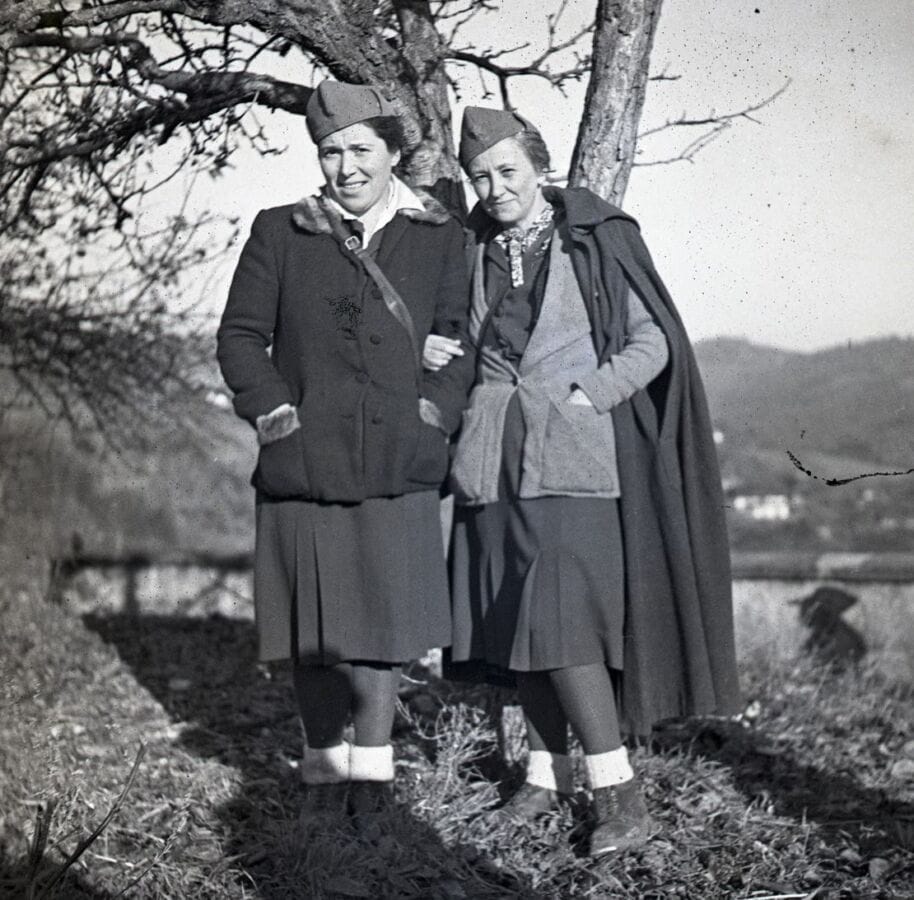
Her papers include a manuscript entitled:
O prelasku kolonizacije partizanske djece krajem augusta 1942 u ruke klerofašista – Karitasa Nadbiskupije zagrebačke. [On the Transfer of the Placement of Partisan Children into the Hands of the Clerical Fascists — Caritas of the Archdiocese of Zagreb — at the End of August 1942.]
The title itself reveals a strongly hostile political attitude toward Caritas. This is the main difference between Diana and Marinić: one was a Catholic, the other a communist and an opponent of Caritas.
In that text, she claims that after the liberation, documentation on approximately 30,000 children was collected from several registers, including those of Caritas and the Ministry of Social Welfare, and that an office was established which spent months tracing children and returning them to their parents. (Archival reference: HR-HDA-1753, Ivan Očak fonds, box 2.)
Kamilo Brössler (1901–1967)
He was born in Varcar Vakuf (present-day Mrkonjić Grad), into a family of Czech-German origin. He died in Zagreb.
Most interestingly, Brössler held an official state position, had powers and access to institutions, and could organize the placement of children. Diana Budisavljević did not hold such an official position.
More importantly, Brössler’s role in caring for Serbian children was recorded in historical literature long before Diana’s diary was published in 2002.
| Period | Position |
|---|---|
| 1928–1938 | Head of the health education department at the School of Public Health in Zagreb |
| 1938–1941 | Head of social protection in the Banovina of Croatia |
| 1941–1943 | Senior official responsible for the social protection of families and children in the NDH |
| 1945–1954 | Official at the Ministry of Social Policy of the People’s Republic of Croatia |
| 1954–1960 | Professor at the Higher School for Social Workers in Zagreb |
As early as 1942, Brössler worked with Tatjana Marinić, who ran a school for childcare workers and participated in caring for children in Jastrebarsko and Donja Reka.
Under the NDH, Brössler held a higher official position than Tatjana. After May 1945, the situation was reversed.
Tatjana became a senior figure in the new social protection system, while Brössler continued as an official.
This is interesting in light of what we have already established: Tatjana confiscated Diana’s card index and later participated in editorial changes to testimonies about wartime child welfare.
Who actually decided the fate of Serbian children?
Long before Diana’s diary appeared, historian Narcisa Lengel-Krizman published excerpts from the NDH Ministry of Social Welfare’s order of August 23, 1942.
The order was issued by Minister Lovro Sušić, while Brössler was a senior official in the responsible department. Documents cited by historians show that Brössler was authorized to sign urgent correspondence concerning the implementation of these measures, in cooperation with the ministry, the Red Cross and Caritas.
It stipulated that children from the camps were to be handed over to:
- Their parents, but only if there were no political reasons against the handover.
- Croatian and Catholic rural and urban families.
- State and private children’s homes where circumstances required it.
More seriously still, young children for whom the necessary personal information was unavailable were to be declared foundlings, meaning children of unknown parents, and placed under the relevant legal provisions. All children covered by the order were considered wards of the state child protection service.
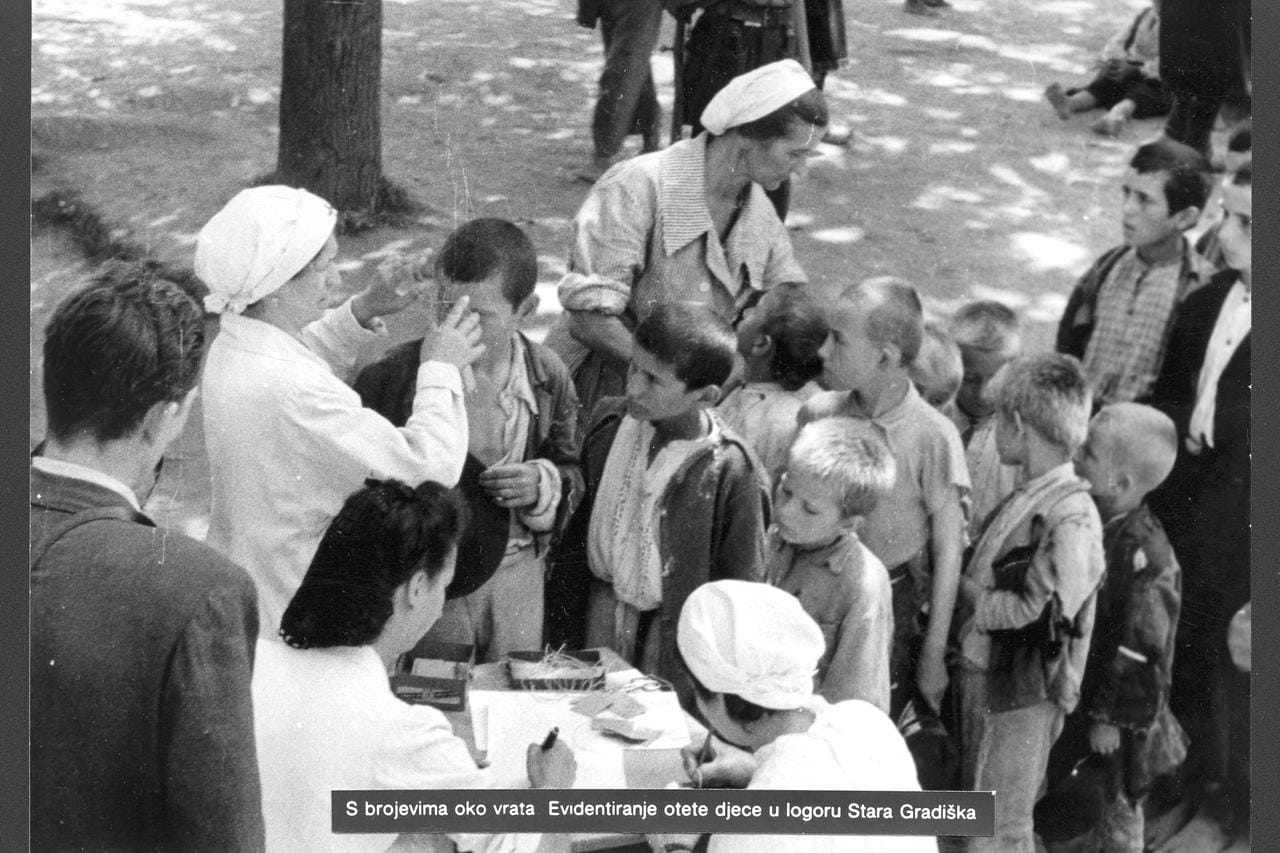
This order is especially significant for three reasons.
First, biological parents did not have an unconditional right to take back their child; the state could invoke political reasons.
Second, the state explicitly directed placements toward Croatian Catholic families.
Third, for the youngest children whose identities had not been established, there was a mechanism for registering them as children of unknown parents.
This is direct evidence of state control over the children’s family status and placement. The document itself does not order individual baptisms, but reveals an administrative mechanism through which children could lose their connection to their origins.
The usual account of Diana emphasizes that she managed to obtain permission to take children out of the camps. But the documents reveal another side: the NDH leadership made the decisions about moving the children, providing transport and arranging their placement.
Documents cited by historians show that Brössler was authorized to sign urgent correspondence concerning the implementation of these measures, in cooperation with the ministry, the Red Cross and Caritas.
Everything attributed to Diana was therefore actually done by Brössler. Tatjana Marinić was also there, and her role was far more important than Diana’s. Why, then, are they not mentioned? Because they were NDH employees, then “Partisans,” and after the war held positions in Tito’s Yugoslavia. Diana is better suited to a romanticized fantasy because she was a Catholic “volunteer.”
All this clearly shows that Diana, Brössler and the others were in fact NDH personnel assigned to transport and place children. Mothers were often killed or sent to forced labor in Germany, while children were placed in homes or with Catholic families. After the war, a state project to convert abducted Serbian children to Catholicism was presented as humanitarian work.
What else does Diana’s diary say?
Many people have seen the film and read superficial propaganda pieces in the domestic press, but few have actually read the diary. It contains a wealth of interesting details. Here are some:
- January 1943 — an interesting entry in Diana’s diary
Two important conversations took place that day:
- At 9:30 in the morning, Diana and Marko Vidaković visited Archbishop Alojzije Stepinac. They asked Caritas to prepare to receive children in the event of large-scale evacuations. According to Diana’s entry, Stepinac agreed to help and announced consultations with Monsignor Pavao Jesih.
- In the afternoon, Diana spoke by telephone with the German captain von Koczian (Gustav von Koczian-Miskolczy). He relayed information about planned operations, the removal of parents for labor in Germany and the placement of their children through Caritas.
This is very important: on the same day Diana discussed the care of children with a representative of the Catholic Church and a German officer, concerning children who might lose their parents as a result of forthcoming military operations. Clearly, then, Diana was not rescuing children on her own, but was part of a state military operation.
A channel to Pavelić through a Vatican representative
The diary then introduces Giuseppe Carmelo Masucci, a Benedictine monk and secretary to the papal legate in Zagreb.
Diana and Vidaković visited him on January 29, 1943, and on February 2 recorded that Masucci intended to speak to Pavelić the following day (p. 119).
Did a copy of the card index end up in Stepinac’s safe?
Diana writes that after Kamilo Brössler’s dismissal, she feared a search of her apartment and confiscation of the card index.
Her associate Ivanka Džakula therefore copied the records, and Marko Vidaković took one notebook to Archbishop Stepinac. According to the entry, Stepinac locked it in a safe in Vidaković’s presence (p. 126).
This raises a very specific archival question: where are all the copies deposited with the Archdiocese of Zagreb, and do they contain information missing from the card index later confiscated?
Dinner with Maks Luburić at the Stara Gradiška camp
This is one of the most unusual scenes in the entire document.
On arriving at Stara Gradiška, Diana and Dragica Habazin find Vjekoslav Maks Luburić, two ministers and German officers there.
After waiting, they are invited into the dining room, where, according to the diary, they attend a dinner at which the ministers toast Luburić and praise the organization of the camp.
Postwar diaries
Toward the end of the war, Brössler, Marko Vidaković, Diana Budisavljević and many others began keeping diaries and notes to avoid ending up in prison.
They also had help from Tatjana Marinić, who joined the Partisans in September 1943, a year and a half before the capture of Zagreb, and helped her former colleagues.
For example, on June 17, 1945, Diana engages a lawyer over a report by her associate Marko Vidaković. After the war, she learns that Vidaković has submitted a report to the authorities and others. She considers it inaccurate and prepares a response with the lawyer’s help, which her daughter translates. She considers sending it to OZNA, but decides against it while Vidaković is in prison (pp. 169–170).
Brössler wrote his diaries, while Marinić confiscated Diana’s card index. Diana wrote her own diaries and threatened Marko with a lawyer over his diaries and statements.
They were fortunate to have been members and associates of the social welfare ministry, making it easy to conceal their true roles and present themselves as secret opponents of the regime.
How is it possible that Tatjana Marinić did not remove Brössler and Diana? As you can see, there is considerable evidence that they altered one another’s statements and threatened each other with prosecution. It may be assumed that they eventually realized it was best for everyone to keep quiet and leave each other alone.
Austrian researcher Wilhelm Kuehs, who studied the original German text of “Diana’s Diary,” says that he could not obtain the complete text:
“You say the diary was censored?
— I believe it was. Dr. Szabo told me she removed parts of the manuscript for privacy reasons. These passages concern Diana’s private affairs, as well as conflicts between Diana and other participants in the rescue. Some people, such as Tatjana Marinić, had to be left out of the diary. Yet other sources tell us that Tatjana Marinić played a major part in rescuing children from Jasenovac, even in the initial conception of Diana’s list.”
The question of the authenticity of “Diana’s Diary”
Diana’s diary was first published on November 29, 2002 in the newly established Croatian state, 30 years after her death. There are serious questions about how the text was edited and translated.
The new state made enormous efforts to remove the stain of Jasenovac and justify the actions of Archbishop Stepinac, whose canonization was hoped for. The suddenly discovered diaries should be viewed in that light.
The publishers were the Croatian State Archives and the Jasenovac Memorial Site. The editor was Josip Kolanović, and Diana’s granddaughter Silvija Szabo prepared the translation from German into Croatian.
In a 2022 study, historian Jure Krišto points out that this is not a conventional diary written daily in its final form.
In his interpretation, Diana made brief notes during the war, then organized them and added explanations. This raises three questions: when the final entries were produced, what may have been added later, and how faithfully the translation follows the original.
That is an interesting way of writing a diary, with all the supporting documentation previously confiscated. And then, 30 years later, it turns out that something had remained with the family after all?
As early as 2007, Serbian historian Milan Koljanin also criticized the edition because the complete German original was not published alongside the translation. It contains an excerpt in German, but not a complete parallel text.
- May 2019 — the “Ivo Pilar” citizens’ initiative
In its article “Sjećanje na Dianu Budisavljević – ideologija i nametnuto kolektivno sjećanje protiv povijesne znanosti” [Remembering Diana Budisavljević — Ideology and Imposed Collective Memory against Historical Scholarship], it asks how the authenticity of the published translation can be guaranteed if the German original is not publicly available.
It also criticized the 2018 RTS documentary Diana’s Children, describing some of its historical claims as falsifications.
My own comment is that we cannot reach a final assessment without the complete diary. Some things remain hidden.
- April 2020 — Mladen Pavković
In an article for the Croatian portal Kamenjar, he goes considerably further and explicitly claims that the story of Diana Budisavljević was invented. His main argument is that such an operation could not have taken place within the NDH without the Ustaša authorities’ knowledge.
An important detail I found in Austrian writer Wilhelm Kuehs’s account
In an interview with B92 on October 19, 2017, Kuehs said that he met Silvija Szabo in Innsbruck in 2015 and asked for the original German diary.
According to him, he received only a fragmentary, censored version and therefore had to reconstruct certain events using other sources.
This matters more than most polemical articles: a researcher who had direct contact with the heir claims that he was not given the complete source.
More importantly, an academic paper published in the journal Témoigner states that Silvija Szabo acknowledged omitting certain private comments and entire episodes from the published text.
This means that what we read today is a translated and editorially abridged text, not the complete original document.
Tito’s relatives in Zagreb and members of the Broz family in senior NDH positions
Remember the story that Ranković fell out of favor with Tito over wiretapping, or over some “documentation from Jasenovac.” Jovanka Broz, née Budisavljević, spoke about this in a television interview. Perhaps we are on the right track toward identifying the records concerned.
During my research, I came across another Broz often mentioned on Wikipedia alongside Diana, Brössler and Tatjana Marinić in accounts of “rescuing children”: Vladimir Broz.
“Wikipedia — Alongside Tatjana, the organizers of this rescue operation included Diana Budisavljević, Kamilo Brössler, Jana Koch, Dragica Habazin ‘Mother’, Vladimir Broz, Velimir Deželić, Ante Dumbović and others.[5]”
Dr. Vladimir Broz — in charge of trains carrying children
Here, then, we find Dr. Vladimir Broz, responsible for trains carrying children from the camps to Catholic homes.
Confirmation in Diana’s diary entry
In the entry for July 9, 1942, Diana identifies Mr. Broz of the Red Cross as the transport leader and describes going with him and Dragica Habazin to the camp administration to arrange the handover of children.
This is another direct record of Broz’s participation. The passage itself does not give his full name, but the information matches Jana Koch’s testimony identifying him as Vladimir Broz.
A source from 1984 states that Vladimir was director of the Office for Croatian Returnees, which operated within the NDH Ministry of Social Welfare.
That office had access to official documents, funds and the means to issue travel papers and train tickets.
It is particularly interesting that its offices were in the same building as the Croatian Red Cross, and the two institutions worked closely together.
In July 1942, Vladimir Broz led the commission’s journey to the Stara Gradiška camp. According to Jana Koch’s testimony, the commission included Croatian Red Cross nurses, among them Dragica Habazin and Diana Budisavljević.
Jana Koch also identifies him as the leader of the second transport on July 14, 1942, when the group again encountered the camp commander Maks Luburić. On that occasion they all dined together at Jasenovac — Broz, Diana, Maks Luburić and the others.
As you can see, there was nothing secret about this. Everything was open and consistent with official state roles.
Zbornik sjećanja: Zagreb 1941–1945 [Collected Recollections: Zagreb 1941–1945], volume 3, published by the Institute for the History of the Workers’ Movement of Croatia and Školska knjiga, 1984.
Pages 278–290 contain Jana Koch’s testimony, entitled Spašena su mnogobrojna naša djeca [Many of Our Children Were Saved].
She writes that Vladimir Broz’s office was a strong base for their work:
“There we obtained the money we needed, documents and travel tickets.”
More importantly, she states that members of the underground network used documents from the Office for Croatian Returnees to travel as Red Cross delegates or personnel.
According to Jana’s testimony, then, an NDH state office was also used to assist the underground Partisan network. She explicitly says that this connection lasted until Vladimir joined the Partisans in 1943.
The surname Broz is not particularly common, and there is a strong possibility that Vladimir was related to Tito. I have devoted considerable time to researching this question, but do not have enough information.
Interestingly, Vladimir Broz joined the Partisans in 1943, but after the war his trail disappears. As though the earth had swallowed him up. Perhaps his surname made it inconvenient for people to know about him?
Vlado and Branko Broz from Zagreb — Tito’s nephews in Drvar
German documents also show that the head of German intelligence, Hans Helm, inquired about Tito’s relatives in Zagreb:
The authors provide the following chronology:
| Date | What was recorded |
|---|---|
| September 17, 1943 | Hans Helm asks the NDH police whether Tito has relatives in Croatia and where they live. |
| September 17, 1943 | Dr. Benak replies that Tito has no known relatives in Zagreb. |
| September 22, 1943 | Tito’s nephews Vlado and Branko Broz leave Zagreb and join the Partisans. |
| January 4, 1944 | Date of a letter from the 13th Proletarian Brigade referring the two brothers to the First Proletarian Corps. |
| March 1944 | Helm obtains the captured letter and again demands an explanation from Benak. |
Source: Odić and Komarica, 1988, page 30
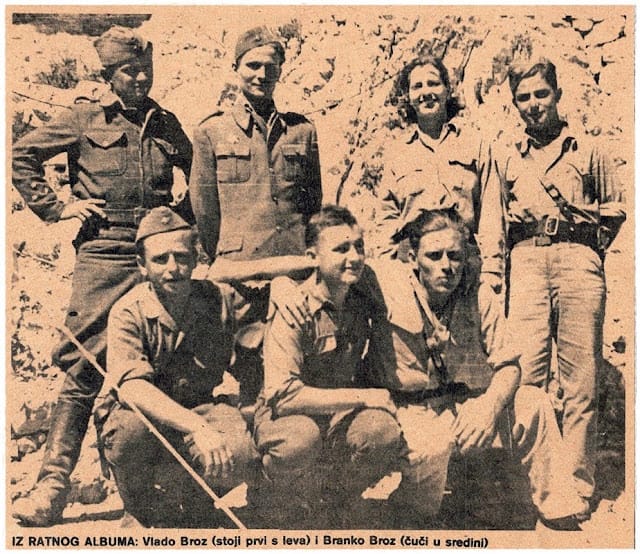
Vlado Broz was in Partisan uniform in Drvar with another of Tito’s nephews (the sons of Tito’s brother Slavko). Note that Vlado and the Vladimir Broz mentioned earlier were probably not the same person; we do not have enough information.
Branko Broz, who served with his brother Vlado in the Supreme Commander’s escort, speaks about saving the Supreme Headquarters’ archives…
I found a roster of members of the 13th Proletarian Brigade. It lists:

Branko Broz was among those who returned to Drvar to remember the early morning of May 25, 1944, and all the other mornings, days and nights recorded in the world’s histories.
Ljubomir Broz — a Croatian Home Guard colonel and a contact with Tito
Ljubo Broz was a Croatian Home Guard officer with the rank of colonel. His wife Dragica and their daughter maintained contacts with the Partisans.
Zena Kalođera — “Od agitpropa do rajonskog obavještajnog centra” [From Agitprop to the District Intelligence Center], Zbornik sjećanja: Zagreb 1941–1945, volume IV, 1984, pp. 389–390.
Previously published in Zagreb 1941–1945, Spektar, Zagreb, 1972. Read the original testimony — scanned page
On page 389, Zena Kalođera writes:
“One of these was an agreement with Home Guard Colonel Ljubo Broz concerning the transfer of a Home Guard regiment to the Partisans.”
She goes on to say that she carried out the task through Vinko Jumić, whom she personally put in contact with Broz.
A German document from 1944 — Colonel Ljubomir Broz
Report of the German 2nd Training Battalion, September 4, 1944 • Tarčin, near Sarajevo, “Report on Events in the 9th Croatian Mountain Regiment”
A published translation of the German document. The first footnote gives the archival reference for the original, while the third identifies Broz’s first name as Ljubomir.
Open the document and archival notes
znaci.org
The document describes the following events:
- September 1, 1944. Colonel Broz receives orders to attack the Partisans at Ivan-sedlo.
- September 2, 03:30. He refuses to carry out the attack as ordered.
- He later sends two soldiers with a white flag to establish contact with the Partisans.
- A Partisan commander comes to his headquarters and negotiates with Broz.
- At 22:00, Broz orders the positions abandoned and Tarčin surrendered without a fight.
- German officers prevent the action and arrest Broz and six other officers. Those arrested are then transferred to Sarajevo.
The German report also records that during these events seven officers and 125 Home Guard soldiers went over to the 9th Krajina Brigade.
Exact archival reference for the German original: Archives of the Military History Institute, German collection, microfilm London-8, frame, registration No. 302.649.
What have we established about the different members of the Broz family?
| Person | Confirmed role | Relationship to Tito |
|---|---|---|
| Ljubo Broz | According to testimony, a colonel in the NDH Home Guard; contacts with the Partisan underground | Not established |
| Dragica Broz | Ljubo’s wife; sheltered underground activists and hid material | Not established |
| Vladimir Broz | Head of the Office for Croatian Returnees; participated in transports of children in 1942 | Not established |
| Vlado Broz | Tito’s nephew; joined the Partisans in September 1943 | Nephew |
| Branko Broz | Vlado’s brother; joined the Partisans in 1943 | Nephew |
Stepinac, Caritas, former Ustaša members and Tito
From the outset, the new communist state under Tito admitted enormous numbers of former Ustaša and Home Guard members into its ranks. Some had been senior officials. Evidence of this can be found in the family connections of Tito and Jovanka, whose relatives were Ustaša officials, or perhaps even officers, who later joined the new state.
Tito visited the pope, associated with the Society of Saint Jerome and took steps to conceal Ustaša archives that clearly connected the Catholic Church and Caritas with the Ustaša idea of converting one third of the Serbs to Catholicism.
That is why the past of Brössler, Tatjana Marinić and Vladimir Broz is concealed in the historical narrative. It is the central motive behind the story of Ranković’s downfall and the reason Jovanka Broz was placed under house arrest.
Diana was insignificant and had the fewest connections to former Ustaša members, so she became the focal point around which the romanticized and distorted story of the supposed “rescue of children” was constructed. Her story is convenient because she was unlike the others — neither an NDH state official nor later a communist. She was a “volunteer” who helped the NDH operation to convert children to Catholicism.
The children were not rescued: they were taken away, and their parents killed. According to the available information, only a few dozen children found their parents. Of 12,000 children, approximately 5,000 are presumed to have survived, and most were converted to Catholicism. That is the whole truth.
Legal provisions governing the taking and return of children
How did the abduction of children actually work? Most parents were killed in the camps, while many were sent to slave labor in Germany. Catholics adopted the children. If no one wanted them, since many were ill, they were returned to a home, where most died because of the appalling conditions. There is evidence that some adopted children were treated as slaves by those families.
The few surviving parents could request their children back if there were no “political reasons” preventing it. The political condition meant that a parent must not be an opponent of the NDH regime, but in practice parents were often required to prove their loyalty as NDH citizens by converting to Catholicism.
The regulation of August 23, 1942 is important here. According to the academic paper that quotes it, it discusses returning children to their parents if there are no “political reasons” against it, and separately discusses placing children with Croatian Catholic families.
What did NDH law actually prescribe?
I found the Ministry of Social Welfare’s provision of August 23, 1942, which regulated to whom children from reception centers could be handed over.
It lists three possibilities:
- To their parents — provided there are no “political reasons” against the handover.
- To Croatian and Catholic families — for placement and upbringing.
- To state and other children’s homes — where special circumstances require it.
This distinction matters: the requirement that a family be Catholic applied to foster families, not biological parents. For parents, the stated condition was political.
Here is an example from an official 1942 report showing the number of children returned.
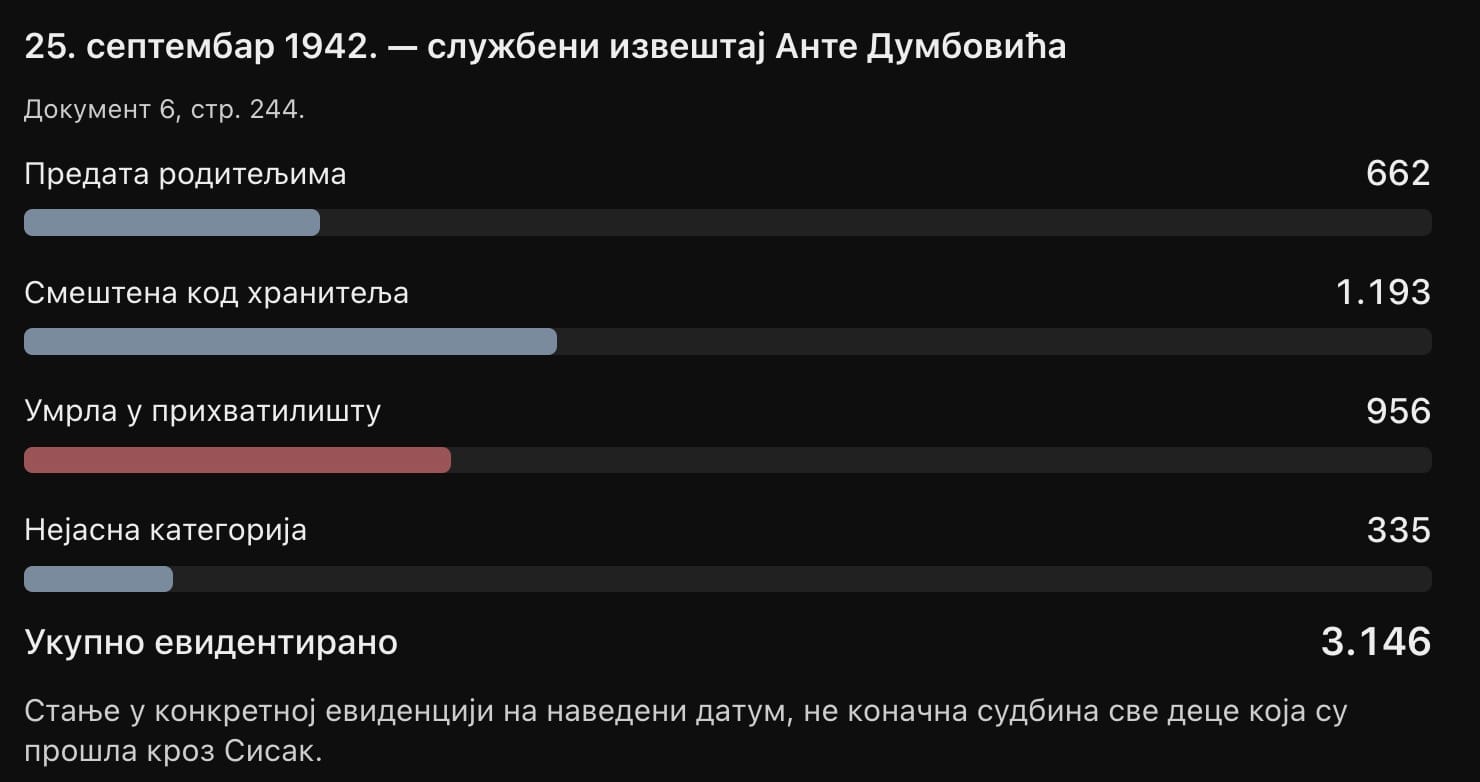
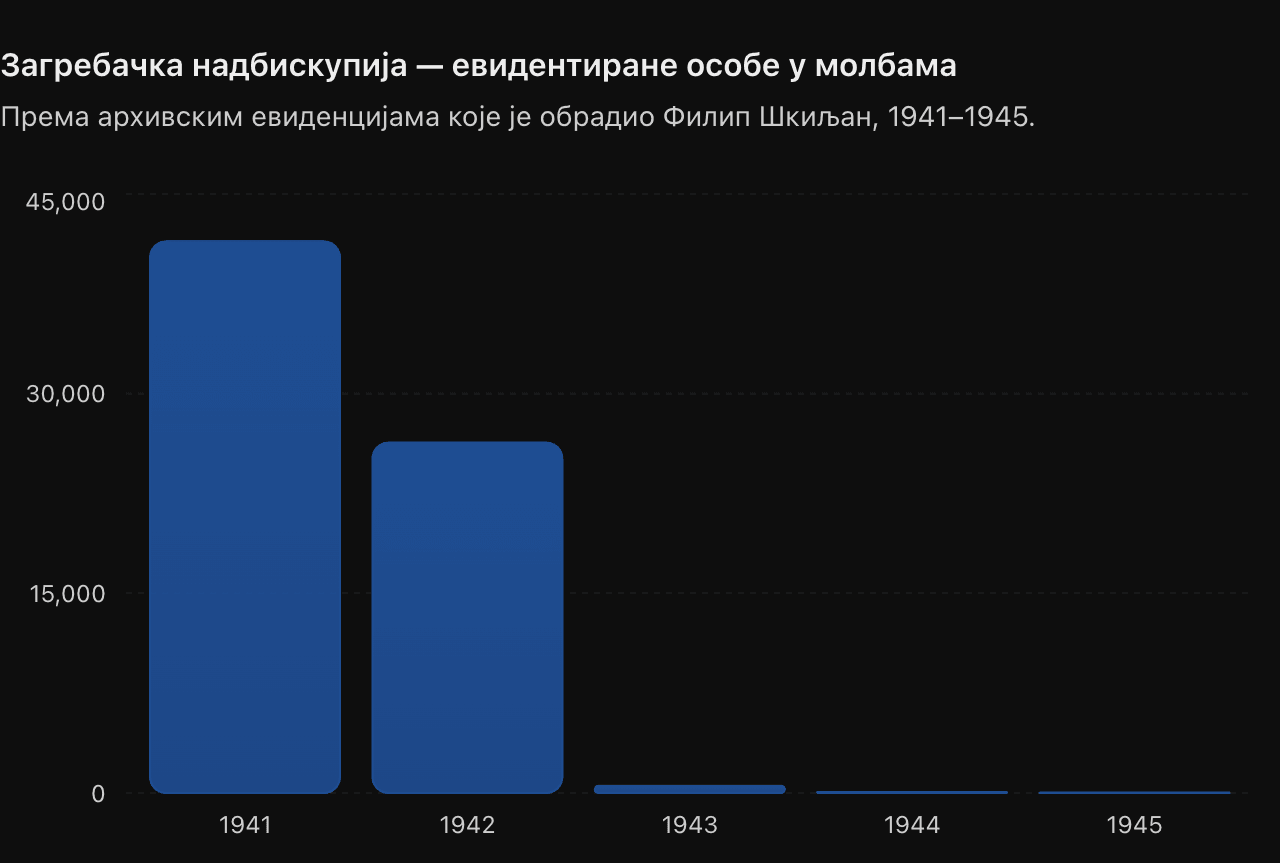
The figure of 662 children returned to parents from the Sisak area is interesting. Filip Škiljan’s research records 476 applications to convert to Catholicism submitted by Serbs from the Sisak area in 1941–1942. We do not know whether these were parents seeking their children or other Serbs from the area, but the figures say a great deal about the situation at the time.
| Applications to convert from Orthodoxy to Catholicism in the Sisak area during the war | at least 476 | Research by Filip Škiljan |
NDH regulations on religion and the family
| Date | Regulation | What it actually stipulated |
|---|---|---|
| May 3, 1941 | Legal provision on conversion from one religion to another | Regulated the registration and recognition of a change of religion. |
| May 9, 1941 | Instruction of the Zagreb Archdiocesan Spiritual Court, No. 4104/1941 | In certain cases where parents were received into the Catholic Church, their minor children were also required to convert. |
| May 27, 1941 | Instruction of the Ministry of Religious Affairs and Education | A parental declaration was sufficient for children aged 7 to 18 to change religion, without separate approval from guardianship authorities. |
| September 26, 1941 | NDH Ministry of the Interior circular, 32711 Pr.-1941 | Conversion to Catholicism was to be taken into account when dismissing people from state service and resettling the Orthodox population. |
How many Serbs converted or applied to convert to Catholicism under the NDH?
Estimate for the entire NDH
≈240,000
Conversions to Catholicism, according to historians’ estimates
Documented — Archdiocese of Zagreb
68,432
Individuals recorded in applications for conversion
These are not two comparable registers: the first is an estimate of completed conversions across the entire NDH, while the second counts people in surviving application records for one archdiocese.
In his paper Preveravanje Srba u Nezavisnoj Državi Hrvatskoj [The Religious Conversion of Serbs in the Independent State of Croatia], historian Milan Koljanin notes that estimates in the literature range from 250,000 to 350,000, but considers approximately 240,000 the most likely figure.
This figure also draws on a wartime report attributed to Zagreb Archbishop Alojzije Stepinac and sent to Pope Pius XII in May 1943. Historians have debated the document’s authenticity, and the figure itself is not the result of a complete register of names.
German diplomatic and intelligence reports from April and July 1942 were already mentioning between 100,000 and 150,000 Serbs converted to Catholicism.
The complete book is freely available:
Pokatoličavanje Srba u Nezavisnoj Državi Hrvatskoj [The Conversion of Serbs to Catholicism in the Independent State of Croatia]
Zagreb, 2019, 464 pages in PDF format. Milan Koljanin’s paper begins on printed page 13, and Filip Škiljan’s on page 101.
Open the complete collected volume (PDF)
Conclusion
Diana Budisavljević has been presented to the public as secretly rescuing Serbian children. This is planned media propaganda in Serbia: first the book, then newspaper articles and media reports, and finally the film Dara of Jasenovac. Orchestrated and directed.
The records and documents presented here make it clear that this image is distorted at the very least. I would go further and say that we are dealing with deliberately disseminated lies.
This article consists of my notes, intended to help anyone interested gain a more realistic picture, provide arguments against propaganda and, I hope, offer leads for future researchers.
Sources
- Nikica Barić — “The Diary of Diana Budisavljević” (2021), pp. 509–513. Contains the most important archival information on Julije.
- Jure Krišto — Helping Orthodox Children in the NDH (2022). Contains information about church documents and conversion to Catholicism.
- Nataša Mataušić and Rajka Bućin — an explanation of the origins and fate of the card indexes (2022)
- Milan Koljanin — “Akcija Diana Budisavljević” [The Diana Budisavljević Operation], Tokovi istorije, 2007 (PDF)
- Croatian Biographical Lexicon — Tatjana Marinić, research quoting Dragica Habazin’s original testimony and an excerpt from Nataša Mataušić’s book, especially pp. 257–262.
- Suzana Leček and Željko Dugac — “Kamilo Brössler – život za druge” [Kamilo Brössler — A Life for Others] (2014), pp. 131–150.
- Ljubo Boban, Hrvatska u arhivima izbjegličke vlade 1941–1943 [Croatia in the Archives of the Government-in-Exile, 1941–1943], Zagreb, 1985, pp. 37 and 252 — reports on Julije and Budak’s possible intervention.
- Croatian State Archives, fonds HR-HDA-1549, I-51/1181–1182 — police report on Julije dated April 25, 1944.
- Liečnički vjestnik, August and November 1944 — Julije’s retirement and his position at the time.
- Ćiril Petešić, Dječji dom u Jastrebarskom: Dokumenti (1939–1947) [The Children’s Home in Jastrebarsko: Documents (1939–1947)], Zagreb, 1990 — documents from 1942 and Brössler’s postwar records.
- Drago Kastratović and Uroš Šoškić, Kozaračka djeca Zagreba [Zagreb’s Kozara Children], Vjesnik, April 1983.
- Tatjana Marinić — “May It Never Happen Again,” Zagreb, 1954.
- Documents on the Regency, March 1945, US State Department — “Foreign Relations of the United States,” 1945.
- Nikica Barić, analysis of the documentary film and wartime sources, 2021.
- Nikica Barić, discussion of the Kozara children, German documents and NDH policy, 2020.
- Jure Krišto, a study of Julije, Stepinac and Diana, 2022.
- Information on the first publication of the diary in Fontes, 2002.